


[ad_1]
Supporters of the Bangladesh Nationalist Party (BNP) show a victory sign in front of a banner with Tarique Rahman’s photo, as the results project BNP’s victory in the 13th general election, in Dhaka, Bangladesh, February 13, 2026. REUTERS/Mohammad Ponir Hossain TPX IMAGES OF THE DAY
| Photo Credit: MOHAMMAD PONIR HOSSAIN
(This article is part of the View From India newsletter curated by The Hindu’s foreign affairs experts. To get the newsletter in your inbox every Monday, subscribe here.)
Around this time in 2024, if you had asked Bangladeshis — or anyone watching the country closely — about its trajectory in two years, they would not have foreseen what is unfolding now. During Prime Minister Sheikh Hasina’s authoritarian rule, the space for both, the political opposition and dissent from citizens had shrunk enormously. While much of the region and world decided to ignore that reality, instead choosing to focus on the country’s skewed “economic growth” and Ms. Hasina’s foreign policy moves, the anger within a large section of society was simmering. We saw that discontent spill onto the streets in 2024, and eventually oust her from power that she so firmly gripped. The “July revolution” marked the beginning of a major shift in Bangladesh politics. The latest episode of the churn is evident in the crucial elections held on February 12, 2026.
To start with, let’s remember that Ms. Hasina’s Awami League was banned from this election. Among the actors who contested, the Bangladeshi Nationalist Party (BNP) won big, with its alliance securing a decisive two-thirds majority.
The BNP’s Tarique Rahman was seen as the frontrunner in this election, so his victory is no big surprise. All the same, there are many important messages that are not to be missed. The Islamist Jamaat-e-Islami-led alliance will be the strongest opposition bloc, with 77 out of the 297 seats in the Jatiya Sangsad or House of the Nation. “With 77 seats, we have nearly quadrupled our parliamentary presence and become one of the strongest opposition blocs in modern Bangladeshi politics,” Jamaat-e-Islami Leader Ameer Shafiqur Rahman said about the outcome, which he termed a “foundation” and “not a setback”.
Given this composition, political analysts in Bangladesh say they expect robust debate and closer scrutiny, particularly on issues of governance, law and order, and constitutional reform, Rabiul Alam reports. We have to wait to see how the country’s altered political landscape evolves. In its campaign appealing to a diverse set of voters, the BNP appeared to escape precise ideological definition or character. It is only from actual governance and policy choices that a regime’s true ideological core unfolds. The Hindu’s Kallol Bhattacherjee brought us real-time updates from Dhaka to understand the early messages from the BNP. Here are the highlights from the reportage and analysis in our coverage.
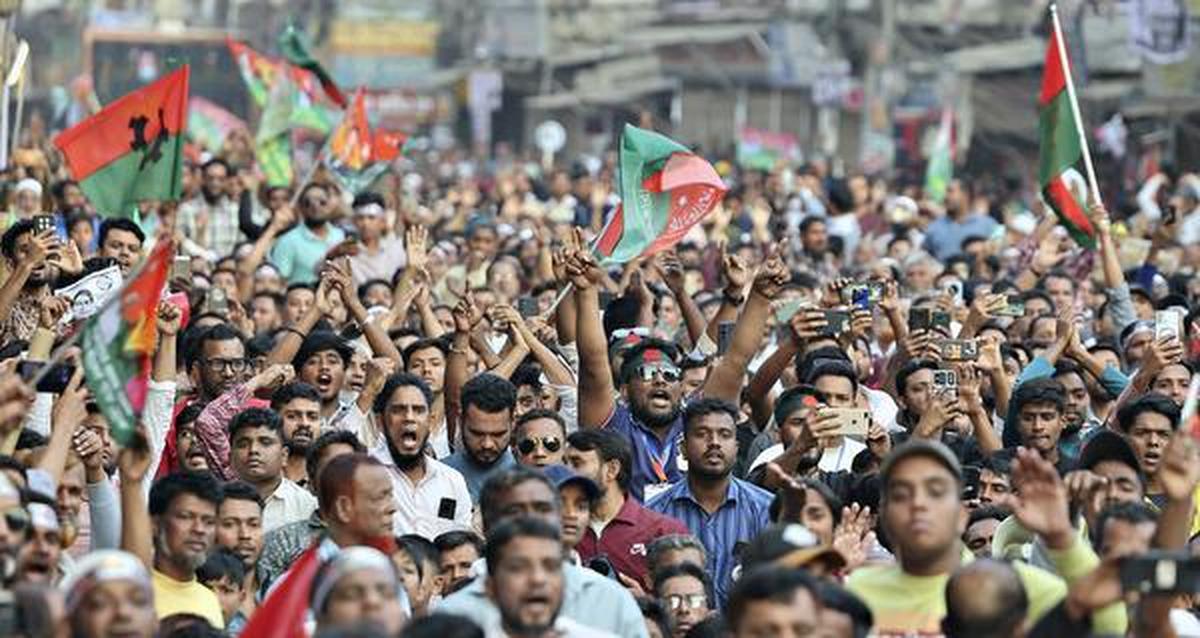
Supporters of the Bangladesh Nationalist Party (BNP) chant slogans, during an election campaign rally attended by the party chairman, Tarique Rahman, ahead of the national election, at Jatrabari, in Dhaka, Bangladesh, February 9, 2026. REUTERS/Mohammad Ponir Hossain
| Photo Credit:
MOHAMMAD PONIR HOSSAIN
Even as the results were emerging, commentators began weighing in on what the BNP’s victory and the Jamaat’s vote share means for India. Of course, it is a pertinent question, regionally speaking. All the same, it necessitates a close reading what the outcome means for Bangladeshis. Understanding the poll’s implications for Bangladeshis who sought change is critical to understanding what it means beyond. In this detailed Ground Zero feature, with diverse voices from Bangladesh, Kallol Bhattacherjee unpacks precisely that. As Bangladesh prepares for its first elected government since Ms. Hasina’s ouster in August 2024, the road ahead remains fraught with challenges, he writes, observing: “With the BNP planning to make its position clear, the Jamaat seeking to assert its parliamentary strength and secure a greater role in national politics and India-Bangladesh relations, and Awami League cadres mobilising for a potential confrontation, Dhaka looks less like the site of a concluded electoral contest and more like the staging ground for another political showdown.” Dhaka-based media commentator Barek Kaiser told him: “We just had an election. But we might soon end up with a real conflict. Read ‘In Dhaka, a new dawn and a gathering storm’ here.
Our Diplomatic Affairs Editor Suhasini Haidar situates Indian interests within the evolving political stage in Bangladesh. She examines if the elections, held without the Awami League, will prove politically sustainable and what the outcome means for India. WATCH the latest episode of Worldview. Meanwhile, diplomatic sources tell Kallol Bhattacherjee that they see hope for India-Bangladesh ties in Tarique Rahman’s development pitch.
The Top Five
- With a second aircraft carrier deployment, Trump raises the stakes with Iran, writes Stanly Johny
- India tested, from U.S. sanctions to one-sided trade deal by Suhasini Haidar
- Takaichi’s triumph: The Hindu editorial Japan’s snap election results
- Jaishankar denies India has lost ‘strategic autonomy’ – Sriram Lakshman reports
- Sri Lanka steps in and clears way for India–Pakistan T20 World Cup match in Colombo
Published – February 16, 2026 10:07 am IST
[ad_2]
The View from India newsletter bangladesh: the churn and the many challenges ahead


