



[ad_1]
I dragged myself through Delhi’s air this morning, body frozen, throat stinging, visibility dropping to philosophical levels of nothingness; all to arrive at the earliest screening of Avatar: Fire and Ash. James Cameron greeted these Sisyphean efforts by flinging a flaming monolith of 3D garbage straight at my face. It’s perverse really, having had to wade through literal poison to sit through blockbuster poison. One would think wheezing through dense radioactive smog could prepare you for anything, but witnessing this billion-dollar landfill blaze made me slowly asphyxiate for over three hours within the confines of my theatre.

For three hours and change, Pandora feels meticulously engineered and spiritually abandoned. James Cameron once made films that felt like dispatches from the future, but this third chapter in his endlessly self-impressed saga, has lumbered back with renewed conviction, obsessed with square footage and intoxicated by its own gigantism. Bloated with money, myth, technology, and a palpable fear of irrelevance, everything is bigger, louder, and longer in Fire and Ash. Everything is also airless.
Avatar: Fire and Ash (English)
Director: James Cameron
Cast: Sam Worthington, Zoe Saldaña, Stephen Lang, Sigourney Weaver, Oona Chapman
Runtime: 197 minutes
Storyline: The conflict on Pandora escalates as Jake and Neytiri’s family encounter a new, aggressive Na’vi tribe
The grief that opens the film promises depth. Eternal marine cosplayer turned reluctant indigenous patriarch, Jake Sully (Sam Worthington), mourns his dead son from the earlier, Way of Water. Zoe Saldana’s Neytiri rages with an unquenchable hatred and her entire emotional architecture is built around the same loss. Their children orbit between resentment and devotion. The premise suggests that the saga is finally ready to sit in its wounds, but the reality is a parade of plot machinery, stitched out of guilt, revenge, an almost voyueristic appropriation of indigenous mysticism, and a mercenary belief in “family” as a substitute for ideas. Cameron gestures toward some semblance of emotional excavation, only to safely retreat to the comforts of prolonged migraine-inducing 3D battles and sporadic bouts of ritual chanting.

The franchise’s grand metaphor has always been colonialism refracted through its luminous fauna and noble warrior spirituality, but Fire & Ash strains to deepen that. Humans and Na’vi entangle across biology, psychology, loyalty, and trauma. Power wants resources, power wants bodies, power wants belonging. There’s still some genuine material here, especially in the uneasy bond between Quaritch and Jake, two military men doomed to reenact their masculinity as their destiny. Yet, Cameron seems perfectly satisfied with surface-level clarities of speechifying heroes and flattened political spectacle.
Characters speak as if locked inside a corporate focus test, ripe with the contrasts of mystical platitudes and dudebro catchphrases. It’s evident that the performers were labouring under digital lacquer, capable of nuance but trapped inside dramaturgy designed for blunt interpretation.
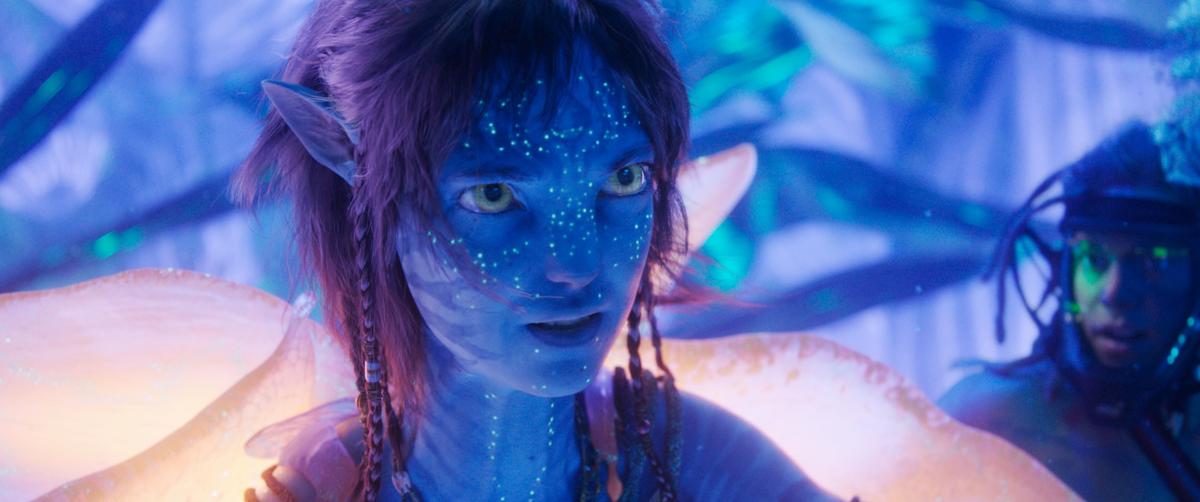
A still from ‘Avatar: Fire and Ash’
| Photo Credit:
20th Century Studios
Jack Champion’s Spider is the film’s most overworked narrative utility tool. The film continuously positions him as the emotional hinge between species — the biological son of Quaritch, the adopted son of Jake’s family, and the human permanently out of place on Pandora. Yet, instead of developing him as a psychologically coherent being, Cameron keeps repurposing him as whatever the plot needs in that moment, whether its a hostage, bargaining chip, test subject, guilt trigger or even the occassional oxygen hazard. His literal dependence on breathing apparatus becomes metaphor in the most on-the-nose way possible, until the film simply decides to rewrite biology and grants him a miraculous, lore-breaking evolutionary upgrade via Eywa and mycelial plant magic.
Kiri (Sigourney Weaver), meanwhile, stands at the intersection of Cameron’s heady ambitions and clumsy storytelling. As the inexplicable child of Grace Augustine’s avatar body, she is supposed to embody Pandora’s spiritual mystery and ecological theology. The mythology frames her as the living bridge between Eywa’s consciousness and Na’vi’s existence, yet the writing reduces that enormity to soft-focus mysticism and conveniently-timed deus ex machinas.
Both Spider and Kiri are built to carry the trilogy’s salvageble themes of hybridity and mutated identity, and both ultimately reveal how Cameron prefers shortcuts and gimmicks over any nuance.

There’s also the new Mangkwan, the heretic Ash People. The film practically shivers with pleasure when they arrive, and Oona Chapman’s electrictrifying turn as their Tsahik Varang, storms the screen with an erotic sense of authority — perhaps the film’s sole saving grace. Though she should be the great new engine of chaos and ideology, she’s soon drafted into Cameron’s preferred function as a catalyst for more setpieces.
The most interesting dynamic in the film is her seductively violent bond with Quaritch. There’s traces of Sean Penn’s oily Colonel Lockjaw from One Battle After Another in how briskly this emblem of military-industrial cruelty turns his genocidal obsession into a fetish for the people his ideology defines as target practice. Cameron frames him as a creature of rage discovering kink through ethnocide, and the film feels bizarrely exhilarated by the revelation. Stephen Lang chews into the role with a feral gleam.
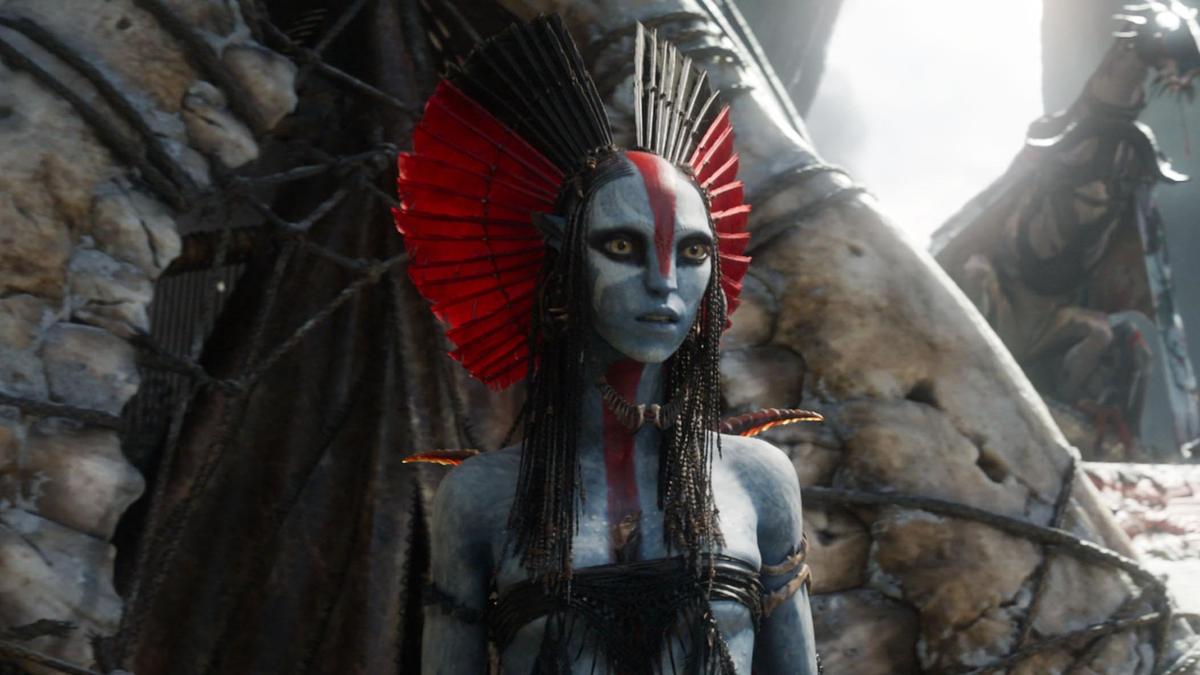
A still from ‘Avatar: Fire and Ash’
| Photo Credit:
20th Century Studios
Cameron has spent years selling the world on how his saga explores the tangled braids between human violence and ecological reverence, but Fire & Ash is fascinated with punishment, purification, and cleansing through violence. The script keeps genuflecting to Eywa, the Great Cosmic Mum, while clearly getting its kicks choreographing annihilation.

What’s especially hilarious is watching a billion-dollar “anti-imperialist epic” manufactured by the world’s most ruthless entertainment empire try to moralise. Fire & Ash wraps itself in environmental preservation and sings hymns to indigenous resilience, only to settle into exquisitely staged obliteration. Cameron preaches sanctimonious balance with one hand and cranks the industrialised spectacle of righteous slaughter with the other. This is cinema as an absolution ritual of sorts, and I think we are supposed to feel spiritually clean after witnessing three hours of eco-friendly carnage, ethically sourced from cutting-edge VFX.
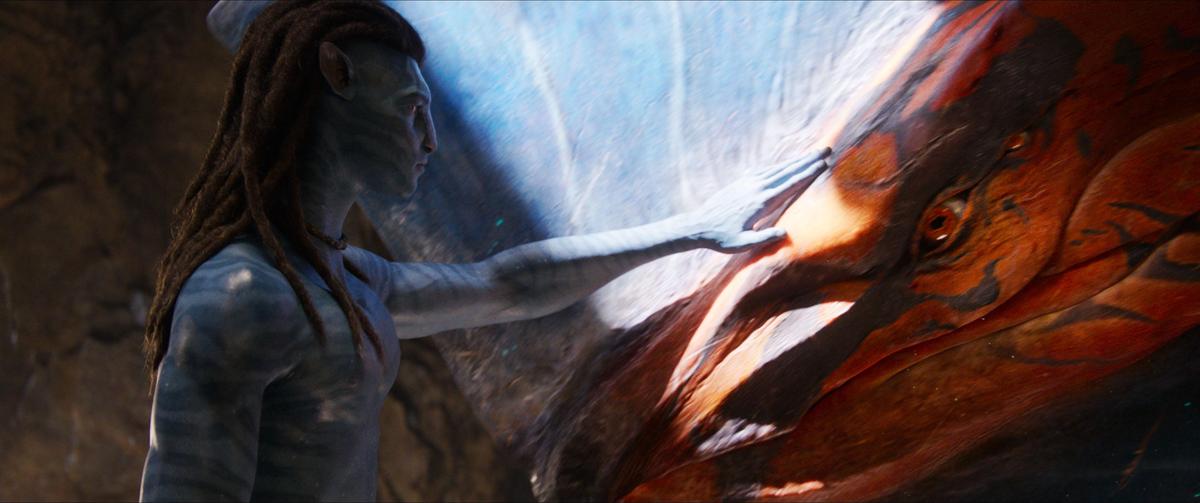
A still from ‘Avatar: Fire and Ash’
| Photo Credit:
20th Century Studios
The immaculacy of the technology admires itself so endlessly, while any meaningful pulses are pulverised under a stack of a million render farms. The relentless rhythm of the spectacle numbed me into an unskippable lull instead of intoxicating me with its excesses. Cameron remains a virtuoso of large-scale movement, yet the splendours of ships buckling, creatures convulsing and landscapes shimmering with impossible light rarely translates into any palpable sense of awe. Action came in waves so frequent and so structurally similar that the sense of escalation dissolved completely into repetition. There is always another chase, ambush, or noble sacrifice rendered with military-grade solemnity, and the franchise’s devotion to the ‘Avatar experience’ has curdled into obligation.

The grand theatricality of a blockbuster once promised wonder, provocation, communion, or at the very least a lingering aftertaste, but Fire & Ash is a resignation to the fact that a beautiful void, scaled up to planetary size, is now enough. The spectacle is nothing more than a sedative, and Cameron’s lofty ambitions had long stopped growing somewhere between the second and third billion dollars. Not even Eywa herself could resurrect my will to live after inhaling this premium-grade narrative sludge.
Avatar: Fire and Ash is currently running in theatres
Published – December 19, 2025 05:41 pm IST
[ad_2]
‘Avatar: Fire and Ash’ movie review: James Cameron’s military fetishism renders the death of wonder in immaculate 3D

