


[ad_1]
A slogan touted as a warning against rising authoritarianism under U.S. President Donald Trump’s administration has, over the past year, grown into one of the largest protest movements in recent American history with millions across the country and in cities abroad, taking to the streets on March 28 under the banner: “No Kings.”
“IN AMERICA, WE HAVE NO KINGS,” declares the website of the ‘No Kings’ movement, a loose but rapidly expanding coalition opposing President Donald Trump, in a message that has now become a rallying cry. It goes on to accuse the administration of unleashing “masked secret police”, pursuing “an illegal, catastrophic war putting us in danger and driving up our costs”, and undermining civil liberties. “Power belongs to the people — not to wannabe kings or their billionaire cronies.”
White House spokesperson Abigail Jackson characterised them as the product of “leftist funding networks” with little real public support. The “only people who care about these Trump Derangement Therapy Sessions are the reporters who are paid to cover them,” Ms. Jackson said in a statement.
In Pictures | ‘No Kings’ protests erupt across the U.S.
Huge crowds of protesters rallied across the United States against President Donald Trump, venting their fury over what they see as his authoritarian style of governing, his hardline immigration policies and the war with Iran.
Picture shows demonstrators hold up their banners as they march across the Memorial Bridge during the “No Kings” protest in Washington on March 28, 2026.
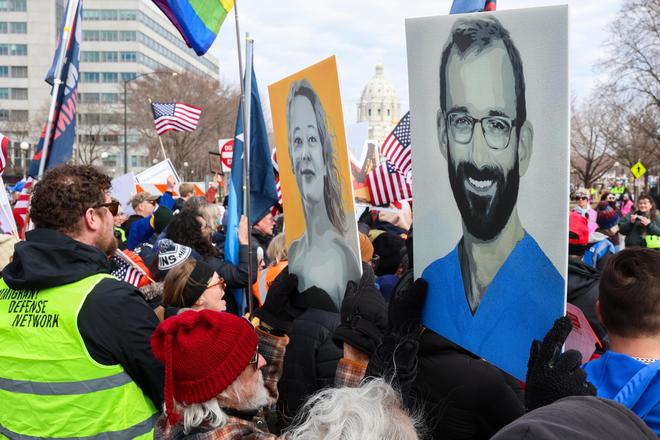
Protesters carry paintings of Renee Good and Alex Pretti, who were fatally shot by federal authorities, during the “No Kings” march outside the State Capitol building in St Paul, Minneapolis, Minnesota, on March 28, 2026. Minnesota is a flashpoint in Mr. Trump’s crackdown on illegal immigration.
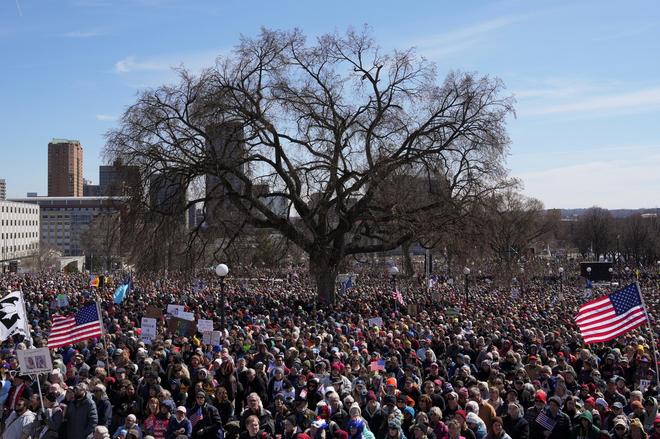
Thousands of people stood shoulder-to-shoulder on the Minnesota Capitol lawn and surrounding streets in St. Paul on March 28, 2026. Some held upside down U.S. flags, historically a sign of distress.
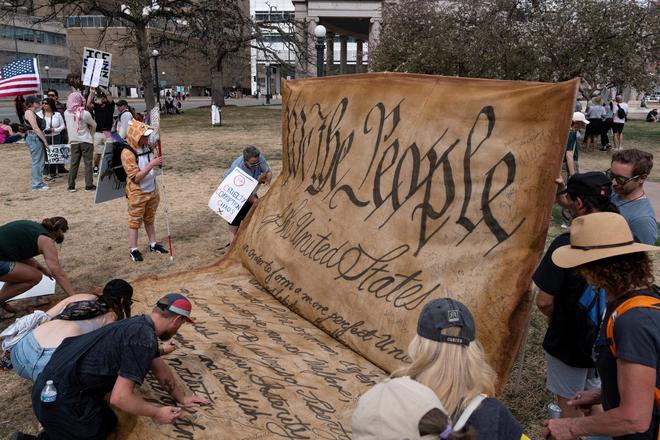
Trump’s immigration enforcement push, particularly in Minnesota, was just one item on a long list of protester grievances that also included the war in Iran and the rollback of transgender rights. Protesters are seen writing on a banner while attending the “No Kings” protest in Denver, Colorado, U.S. on March 28, 2026.
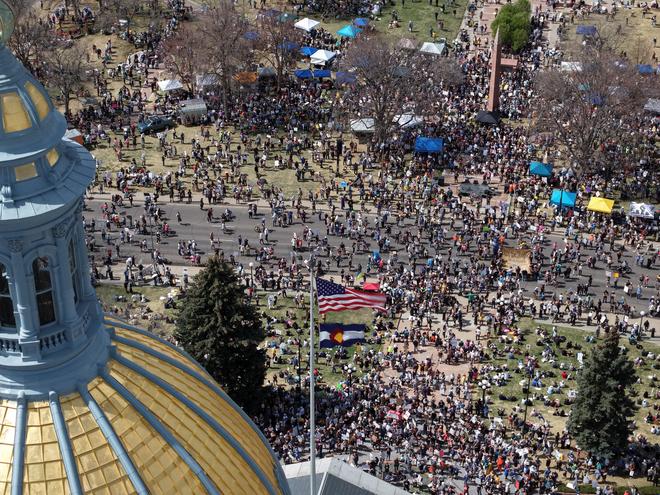
A drone view of a “No Kings” protest in Denver, Colorado on March 28, 2026.
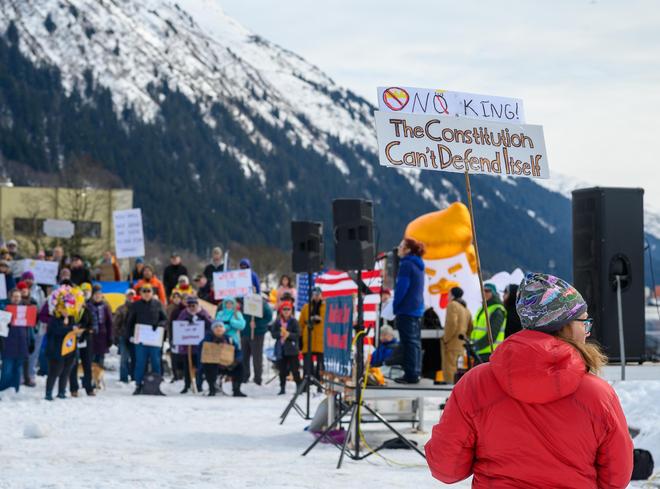
Demonstrators are pictured participating in a “No Kings” protest in Juneau, Alaska, on March 28, 2026. Throughout the day, crowds gathered to march, sing, dance and wave signs in major cities, suburbs and small towns across red and blue States, with huge marches taking place in Los Angeles and New York.
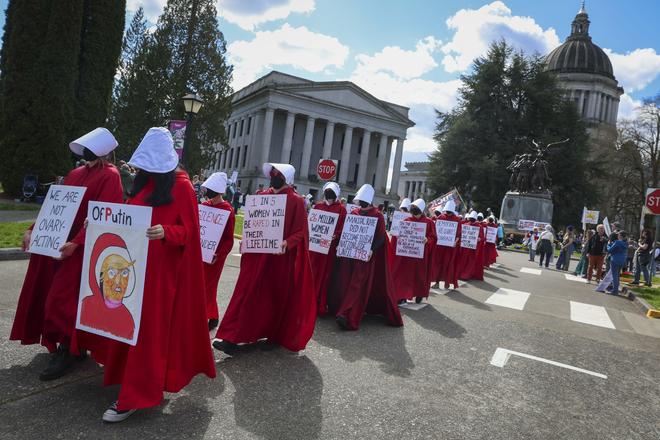
The Olympia Handmaid Brigade joins a nationwide “No Kings” protest at the Washington State Capitol in Olympia on on March 28, 2026.
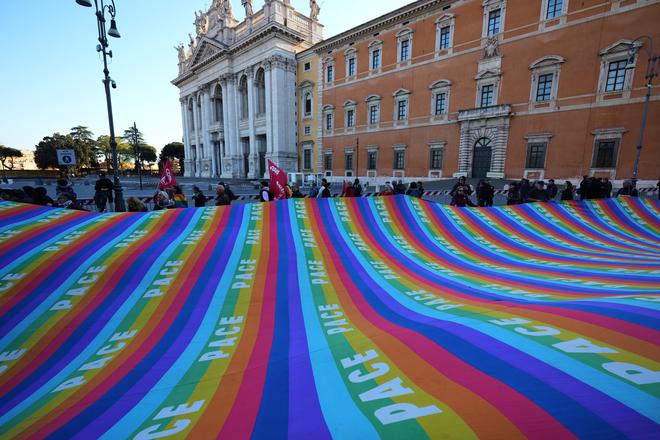
Demonstrations were also planned in more than a dozen other countries, from Europe to Latin America to Australia. In Rome, protesters took part in a national anti-war demonstration organised by “No Kings Italy movement” on March 28, 2026.
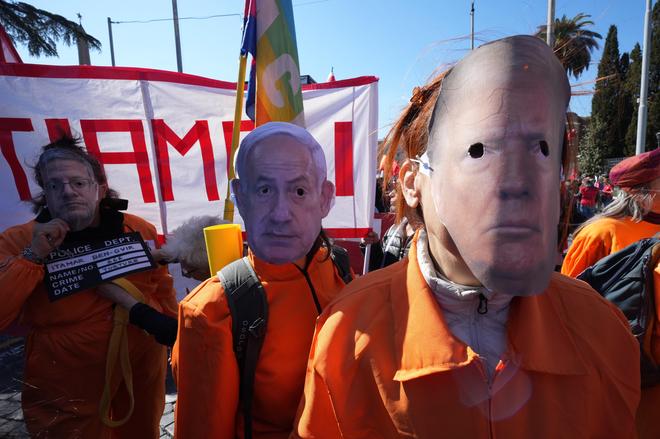
The Italian capital saw thousands marching on March 28, 2026, with defiant chants aimed at Premier Giorgia Meloni, whose conservative government saw its referendum for streamlining Italy’s judiciary fail badly this week amid criticism that it was a threat to the courts’ independence. Protesters also waved banners protesting Israeli and U.S. attacks on Iran, calling for “A world free from wars”.
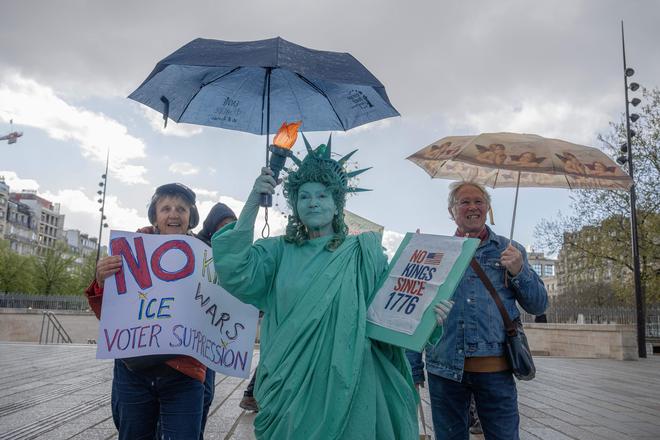
Similarly, in Paris, several hundred people, mostly Americans living in France, along with labour unions and human rights organisations, gathered at the Bastille. Protesters took to innovative methods, as seen here with a woman dressed as the Statue of Liberty taking part in the “No Kings” protest in Paris on March 28, 2026.
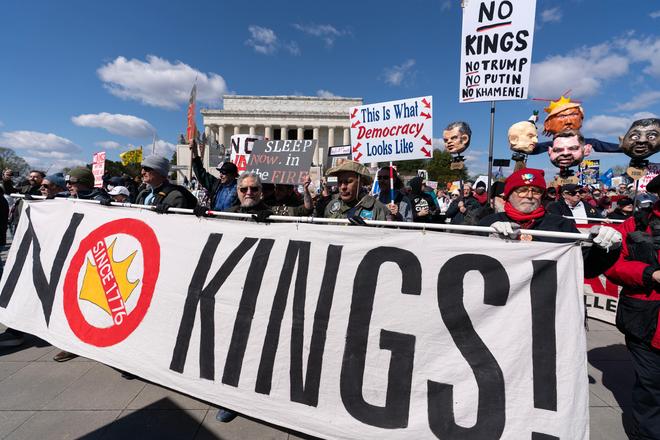
Demonstrators rally in front of the Lincoln Memorial during the “No Kings” protest in Washington on March 28, 2026.
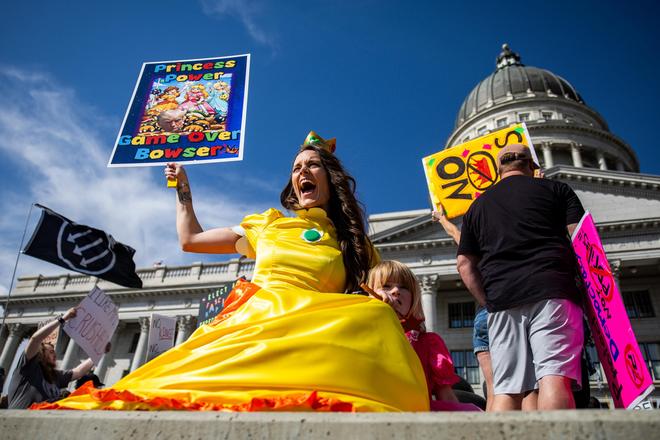
With midterm elections later this year in the U.S., organisers say they have seen a surge in the number of people organising anti-Trump events and registering to participate in deeply Republican States such as Idaho, Wyoming, Montana and Utah. Nicole Kunz, centre, sits with her daughter during a “No Kings” anti-Trump protest at the Capitol in Salt Lake City in Utah on March 28, 2026.
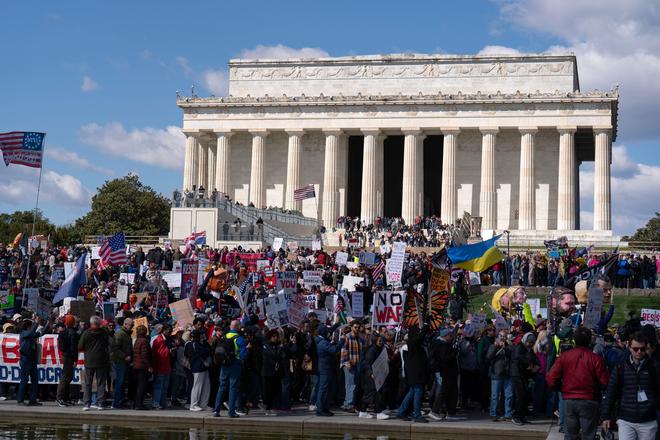
Competitive suburban areas that have helped decide national elections are seeing “huge” increases in interest, said Leah Greenberg, co-founder of Indivisible, the group that started the “No Kings” movement in 2025, and led planning of the March 28, 2026 events. Demonstrators, seen here, are rallying in front of the Lincoln Memorial during the protest in Washington on March 28, 2026.
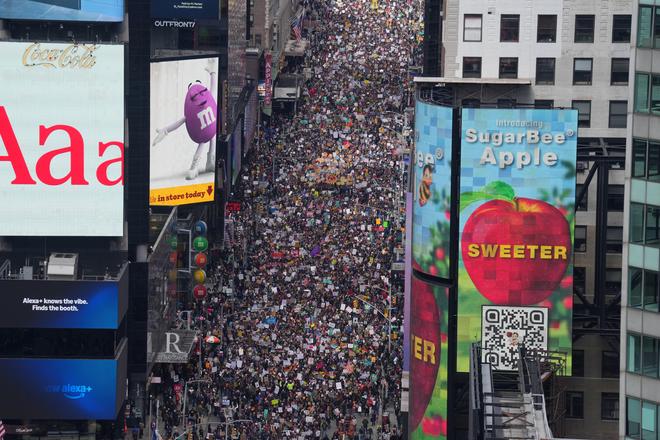
People attend a “No Kings” protest on March 28, 2026, in New York.
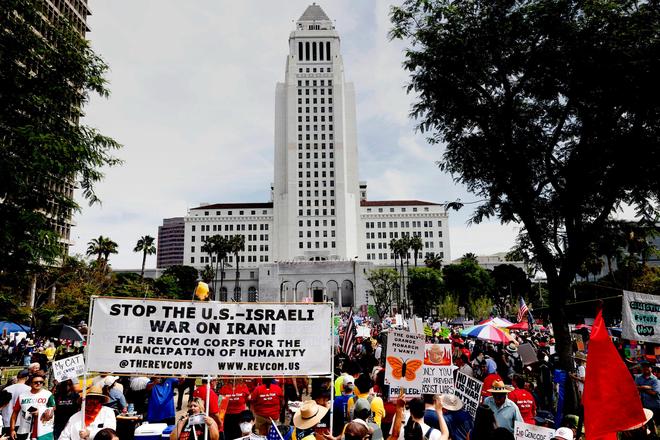
Demonstrators carry signs and join in during a “No Kings” protest at City Hall on March 28, 2026 in Los Angeles.
1/3
According to the organisers, Saturday’s demonstrations, the third nationwide mobilisation since Mr. Trump’s re-election in January 2025, were the largest yet with an estimated eight million people participating in nearly every major U.S. city, alongside solidarity protests in Paris, London, Lisbon and Rome among other cities. The turnout surpassed earlier waves in June and October last year, which drew roughly five million and seven million participants, respectively, according to the organisers.
Grassroots movement
‘No Kings ‘is a coalition-driven protest movement primarily driven by progressive, anti-authoritarian organizations, including Indivisible, 50501, MoveOn, Public Citizen, the American Civil Liberties Union, and the National Action Network. The groups also bring in a broad range of partner organisations, labor unions, legal organisations such as the American Civil Liberties Union, and advocacy groups such as the Movement for Black Lives.

Their stated aim, according to organisers, is to “safeguard democracy from an authoritarian” through “organised, nonviolent, insistent people power”. That message appears to be resonating across a wide spectrum of Americans. While immigration enforcement has emerged as a central flashpoint, the protests reflect a convergence of grievances: the administration’s military posture abroad, especially its war in Iran; rising living costs; alleged voter suppression; and the rollback of civil rights protections.
The symbolic centre of Saturday’s protests was the Twin Cities region — Minneapolis and St. Paul — where tensions over immigration enforcement have been particularly acute after residents stood up to the surge of federal immigration agents the Trump administration sent into the region earlier this year and after the death of two residents, Renee Good and Alex Pretti, who were killed while observing activities by Immigration and Customs Enforcement (ICE).
The flagship rally drew tens of thousands to the State Capitol in St. Paul. Senator Bernie Sanders addressed the crowd alongside actor-activist Jane Fonda and musicians Joan Baez and Maggie Rogers. Later, Bruce Springsteen performed a song titled ‘Streets of Minneapolis’, sharply critical of immigration enforcement policies. A pre-recorded message from actor Robert De Niro was also played at the rally.

The actor said he wakes up “depressed” by the political climate but felt hopeful seeing millions mobilise. He also praised Minnesotans for “running ICE out of town” — a claim that organisers say reflects the growing resistance to federal enforcement efforts.
Protest across the country
Protesters held up effigies of Mr. Trump, Vice President J.D. Vance and other officials in the administration, calling for their ousting and arrest.
In Washington, hundreds marched past the Lincoln Memorial and into the National Mall, holding signs that read “Put down the crown, clown” and “Regime change begins at home.” Demonstrators rang bells, played drums and chanted “No kings.”
In New York City, thousands packed Times Square and marched through Midtown Manhattan, forcing police to shut down major streets.
Demonstrators carried placards reading “No kings, no crowns” and “Democracy, not dynasty,” while chanting slogans. The scale of turnout likely exceeded October’s protest, when more than 100,000 people gathered across the city’s five boroughs.
Donna Lieberman, executive director of the New York Civil Liberties Union, said during a news conference that Trump and his supporters want people to be afraid to protest. “They want us to be afraid that there’s nothing we can do to stop them,” she said. “But you know what? They are wrong — dead wrong.”
In Los Angeles, two people were arrested for assaulting federal law enforcement, according to the Department of Homeland Security (DHS). The Los Angeles Police Department (LAPD) said “multiple arrests” had been made after protesters did not obey dispersal orders in an area near a federal prison.
Several US states also mobilised the National Guard. Since returning to the White House in January 2025, Trump has expanded the scope of presidential power, using executive orders to dismantle parts of the federal government and deploying National Guard troops to US cities despite objections by state governors, though organisers have maintained that the protests remained peaceful.
Why people are protesting
While immigration remains a core issue, the movement’s agenda has broadened considerably since inception. Protesters cite the administration’s Iran policy as a major concern, with fears that an escalating conflict could further strain the economy and entangle the U.S. in a prolonged war.
When it comes to domestic issues, organisers have accused the administration of criminalising protest, eroding voting rights, and prioritising military spending over social services. The cost-of-living crisis, exacerbated, they argue, by policy decisions, has also become a key driver of participation. “Costs are pushing families to the brink,” the movement’s website states. “They’re still trying to rig the rules, suppress the vote, and sabotage our elections. So we’re not stopping either.”
The scale of concerns has helped the movement attract a diverse coalition from civil rights advocates and labour unions to anti-war groups and student organisations.
Critics say the administration’s actions have tested constitutional norms and intensified fears of executive overreach. The “No Kings” movement has positioned itself not merely as a protest campaign but also as a sustained resistance effort.
“We showed up. And it mattered. Millions of us took to the streets for No Kings on March 28th and made it clear: we don’t do kings; not now, not ever. But these days of action are not enough. Because the truth is: they’re not stopping. They’re still trying to rig the rules, suppress the vote, and sabotage our elections. So we’re not stopping either,” the ‘No Kings’ website stated.
The organisers announced a “mass call” on March 31 with leaders and fellow local activists to celebrate the historic mobilization and dig into what comes next.
Anisha Dutta is a journalist based in New York
[ad_2]
‘In America, we have no kings,’ chant protesters as anti-Trump movement grows


