


[ad_1]
In November 3, 2025, Iran’s Supreme Leader Ayatollah Ali Khamenei delivered his annual address on the eve of what Iran terms the ‘National Day of Fighting Global Arrogance’, which marks three important junctures in Iran’s history – Ayatollah Khomeini’s exile by Reza Shah Pahlavi in 1964, the Pahlavi forces’ killing of student protestors at the University of Tehran in 1978, and (most importantly) the seizure of the U.S. Embassy in Tehran by students proclaiming loyalty to Khomeini in 1979. Mr. Khamenei’s address focused on an old effort — to consistently re-legitimise the Embassy takeover and reinforce a revisionist history of the event in the Iranian popular imagination. However, a key feature of Mr. Khamenei’s 2025 address is his description of arrogance or ‘istikbar’ in government. He put forth a two-pillared description:
“‘Istikbar’ (is) self-perceived superiority is of two kinds. One is when a person or a government considers itself to be superior to others but doesn’t interfere with them. This still isn’t a good characteristic. Conceit isn’t a good thing, but it doesn’t create enmity or hostility. It’s simply a bad trait to have. However, there may be a time when a government, a person, a group, or an aggressor considers itself to be superior to others and grants itself the right to push others around, to encroach upon the vital interests of others, and to dictate terms to others. Arrogance in this form is bad.
A government — for instance, it was the British government in one era, and it’s the U.S. today — grants itself the right to establish, for example, ten military bases in a certain country that lacks a strong government or an aware populace, to create facilities for itself, to take their oil, to seize their interests, and to plunder their underground resources. This is ‘Istikbar’. This is the Arrogance we object to, the Arrogance we speak about, and the Arrogance we chant slogans against.”
This article is from The Hindu e-book. Iran: Revolution in retreat
Mr. Khamenei’s immediate intent is arguably to ensure national unity in a nation still reeling from an unprecedented joint U.S.-Israeli bombardment for 12 days in June. However, his description of ‘istikbar’ can be appropriated for a more objective reading of Iran’s rivalry with the United States and one that is far less convenient for a Supreme Leader to admit from the pulpit. This pertains to the fact Iran’s real grievance with the U.S. is not Iran’s aversion to the U.S.’s inherent arrogance (in Tehran’s view), but rather Washington’s stark inconsistency in its approach to Tehran, swinging between cooperation and engagement to hostility and confrontation.
For an Islamic Republic that publicly lambasts the U.S. as the ‘Great Satan’, whenever the U.S. pendulum has swung towards engagement, Tehran has never categorically refused but cautiously reciprocated. Arguably, for Iran, periods of U.S. engagement reflect Tehran’s success in making an arrogant power step down from a disrespectful pedestal. Hence, engagement is part of (and not an exception to) Tehran’s efforts at preventing the United States from threatening the regime.
Whenever cooperation has given way to overt hostility from Washington, Tehran’s leaders have invariably cried vindication of the Republic’s characterisation of the U.S. as an arrogant imperial power, but it has never prevented Tehran from engaging Washington again, despite the latter’s volte face at multiple points since 1979. However, such a response/ reaction is part of the same duality – to present both engagement and estrangement as part of Tehran’s design.
In functional terms, this duality in the U.S.-Iran relationship has usually been triggered by the different, and often divergent, approaches that multiple U.S. Presidents (usually successive) have followed towards Tehran — from Dwight Eisenhower succeeding Harry Truman, through Ronald Reagan succeeding Jimmy Carter, to Donald Trump succeeding Barack Obama (and then Joe Biden). This duality of Iran’s experience, which cumulatively reinforces its view of U.S. arrogance, is outlined below through selective developments in Iran-U.S. relations, before and after its 1979 Islamic revolution.
It is imperative to note, however, that while Iran’s relationship with the United States became structurally hostile post-1979, Tehran’s intent and ability to engage positively with Washington has invariably been motivated by one core logic — regime preservation. Again, functionally, this logic is multi-pillared and has been guided through geopolitical necessities, domestic economic compulsions, and an assessment of threats to national security.
The Policeman of the Persian Gulf
The Iranian people and Iran’s political and military leaders have a long sense of history. Regardless of the government they represent, their outlook towards the United States and their foreign policy priorities, modern Iran’s leaders (especially following its Constitutional Revolution of 1905-1911) have consistently mourned Iran’s historical vulnerability to foreign powers and the latter’s frequent colonial exploitation of Iran’s geography and its resources. This includes several events, stretching from 1907 when the Anglo-Russian Convention effectively partitioned Iran into British and Russian spheres of influence, and then in 1941 when Russian, American, and British troops invaded Iran after accusing Reza Shah (the first Pahlavi King) of hosting Nazi officers. Reza Shah himself, while propelled to power through British and American support, nursed such grievances, such as when he signed a 30-year extension on Iranian oil concessions to the Anglo-Iranian Oil Company, with paltry profits for Iran in 1933.
His son, Mohammed Reza Pahlavi (hereinafter the Shah), arguably held a similar outlook, with the difference being that, compared to his father, Mohammed Reza Pahlavi inherited different geopolitical circumstances and was more apt at leveraging a partnership with the United States to consolidate Iranian power, even as he granted the concessions that were a priority to Washington.
Among the Shah’s early tests in power was his contest with the firebrand, fiercely nationalistic, Mohammed Mosaddegh, elected as Prime Minister in 1951. Mosaddegh’s decision to nationalise Iranian oil and end the existing severely lopsided arrangement that lent the lion’s share of profits to the United Kingdom had spurred a strong British effort to remove Mosaddegh from power and put in place a new architecture in power in Iran, which further empowered the Shah. However, British efforts (especially through Winston Churchill as premier) to lobby the United States in support of this effort remained categorically unsuccessful as long as Harry Truman held the U.S. Presidency. Even as Truman was sympathetic to British concerns, he was resolutely against the MI6’s interventionist advocacy, which he viewed as a deeply colonial project for a dying imperial power. In fact, Mosaddegh relied on Truman’s pragmatic position to engage in dialogue with the U.S., to draw Washington’s support for Iran’s concerns. Even as his famous 1951 meeting with Truman in Blair House yielded little for the Iranian Prime Minister, Truman’s anti-imperial credentials evidently earned him greater trust in Iran. It was his successor, Dwight D. Eisenhower’s decision to greenlight Operation Ajax to engineer a CIA-MI6- led coup against Mosaddegh in 1953, which marked a watershed in Iran-U.S. ties (and for the United States too, for whom Iran 1953 represented the first successful operation to covertly force regime change abroad).
AMBITIOUS PLANS: Prime Minister Mohammed Mosaddegh rides on the shoulders of cheering crowds in Tehran’s Majlis Square, outside the parliament building, after reiterating his oil nationalisation views to his supporters on September 27, 1951.
| Photo Credit:
AP
Note that in present-day Iran, Mr. Khamenei and the Islamic Republic’s clerical establishment eulogise Mosaddegh’s forced removal as among the first modern examples of American ‘istikbar’, but they consistently denounce Mosaddegh’s own turn to Washington for support as his error, and thus de-legitimise Mosaddegh’s accurate assessment of Truman’s position for what it was worth. Eisenhower’s decision, too, was due to a tactful change in the British logic — making a case that presented Mosaddegh as a communist threat, rather than frontloading oil concerns.
Between 1953 and 1978, with the Shah’s domestic position secure (and Mosaddegh’s prime ministerial successors being well integrated with the Palace), Tehran and Washington embarked on a cooperative arrangement that arguably eclipsed several other bilateral partnerships, in its depth and expanse. By 1959, the Shah signed a bilateral defence cooperation agreement with the United States, and even as he signed a Non-Aggression Pact with the USSR to placate Soviet concerns, he allowed American listening posts along the Iranian border with Russia. By 1964, with U.S.-Iran cooperation especially deepening under the premiership of Hassan Ali Mansur, Iran and the United States agreed on a Status of Forces Agreement, providing legal immunity to U.S. troops in Iran, and Tehran received a $200 million loan from the U.S. to purchase American weapons.
By the 1970s, the United States implemented its ‘Twin Pillars’ policy in the Middle East to rely on Saudi Arabia and Iran for the security of energy supply lines. While Washington remained bogged down in Vietnam, Mohammed Reza Shah was unarguably the U.S.’s preferred partner in the Gulf. Between 1970 and 1978, Iran emerged as the largest importer of American arms, accounting for 25% of all American foreign military sales in those years, which resulted in a lightning-fast military build-up that established Iran as the world’s fifth largest military power. Economically, too, the United States remained a significant partner to Iran, with both states signing an economic agreement worth $15 billion in 1975.
This resulted in two crucial characteristics of the Shah’s rule — growing assertiveness and power projection abroad (through interventions in Yemen, Oman, and Iraq) and increasing authoritarianism at home. The Shah arguably realised Iran’s importance as the ‘Policeman of the Persian Gulf’, when he successfully lobbied the Organization of Petroleum Exporting Countries to significantly increase crude prices in 1968, which resulted in mammoth economic dividends for the Iranian treasury.
Arguably, even as he readily gave in to American needs, the Shah was always cognisant of the need to protect Iran from allegations of being a U.S. puppet, and gambling that a deep partnership with Washington and authoritarianism at home would be forgiven domestically as necessary to re-establish Iran’s national power and enable it to claim global leadership. Naturally, opposition forces at home (which included a motley mix of Islamist clerics, Mosaddegh-era nationalists, and pro-Soviet leftists) blamed both the Shah as well as the United States (which helped create the Shah’s infamous SAVAK in 1957) for the clampdown on democratic freedoms. Hence, even after his own expulsion from Iran in 1964, Ruhollah Khomeini’s network in Iran eventually assassinated several prominent figures they deemed responsible for the Shah’s empowerment by the U.S. – such as Hassan Ali Mansur (killed in 1965). A testament to the importance of this assassination was when those involved garnered favourable positions in the post-1979 government.
However, it is also categorically true that at crucial junctures of the opposition’s consolidation in Iran, it is the United States which forced the Shah’s hand towards more liberal policy-making at home. Most prominently, the Jimmy Carter administration’s strong insistence on a liberal human rights policy pushed the Shah to grant key concessions at home and to tone down his ‘autocratic democracy’. It is this set of concessions, including amnesty to political prisoners, press freedoms, halting (on paper) torture of dissidents by the SAVAK, and a commitment to free and fair elections to Parliament, which empowered and enabled Khomeini’s networks within Tehran to consolidate and expand. To be clear, Carter’s policies did not imply receding U.S. military and economic support to Tehran, but rather a disinclination to overtly aid the Shah’s domestic authoritarianism. Carter’s own administration harboured suspicions of the Shah’s growing assertiveness both in the region and outside, generating a need to rein in, but not shun, an important partner. Ultimately, it is the Shah’s own vacillations that led to a climactic surge in popular demonstrations, which eventually ousted him in the cold January winter of 1979.
The fount of anti-U.S. hostility
The February 1979 revolution, which brought Ruhollah Khomeini back to Tehran with celebratory fanfare, did not by any means imply an immediately antagonistic Iranian relationship with the United States by default. It is undoubtedly true that the Iranian opposition and the people rallying behind it often clashed with the 45,000-odd American population in Iran, prior to 1979, and the clerical leaders in Khomeini’s new Islamic Republican Party did harbour deep anti-Western sentiments.
However, the February revolution did not bring a theocratic regime to power, and the Mehdi Bazargan-led interim administration, although blessed by Khomeini, was packed with Western-educated nationalists drawing inspiration from the Mosaddegh-era. In fact, Khomeini’s early approach to the United States was considerably motivated by post- revolutionary paranoia, especially pertaining to the Iranian armed forces. The American-trained Iranian military (and especially its air force) posed an existential threat, which needed to be nipped in the bud to prevent it from counter-revolutionary activities. In a bit of a Catch-22, to prevent this, Khomeini had to engage, and not confront, the United States, even empowering future Foreign Minister Ebrahim Yazdi to covertly engage in backchannel talks with the Americans to prevent Washington from enabling a military revolt. Khomeini highlighted that hostile military actions by the Iranian armed forces could threaten not just Iranians, but also the American population in Iran (through reprisals). Moreover, as political scientist Mohsen Milani also notes, when Marxist forces first attempted a takeover of the U.S. Embassy in February, Khomeini categorically expressed his disapproval, leading the mob to vacate the diplomatic compound.
Bazargan himself sought to embark on a more balanced foreign policy, with “No East, No West” as its slogan, and explicitly stated that Iran would not play the role of the U.S.’s policeman in the Persian Gulf any longer. However, he continued to assert the need for a positive relationship with the United States and the necessity to retain U.S. military advisors in the country (even as he committed to reducing the import of U.S. weaponry). Arguably, during the short life of the interim administration, Khomeini was still in search of elements that would help justify theocratic rule, and was in the process of erecting a new paramilitary drawn from local mosque- centred militias under the control of myriad clerical establishments; this would later become the Islamic Revolutionary Guard Corps. Apart from the U.S. decision to admit the deposed Shah into the United States for medical treatment, it was the second takeover of the U.S. Embassy in November by students who called themselves the ‘Followers of the Imam’s (Khomeini’s) Line’ that allowed Khomeini to categorise it as an organic Iranian expression of anti-Americanism, which necessitated a more theocratic government to give meaning to the February revolution. In any case, Bazargan resigned over his ineffectiveness to protect the Embassy, and the interim government collapsed on November 6.
While the Embassy siege is often characterised as the key break, Khomeini’s motivations were evidently as domestic, with the new Wali-e- Faqi (Supreme Jurist) needing an anchor for internal consolidation, as it was international. Nonetheless, all American cooperation with Iran ground to a halt, and Khomeini famously characterised the United States as the ‘Great Satan’ (with Israel being labelled Little Satan) for the first time on November 5, 1979.
Iran’s modern leaders, including Mr. Khamenei, continue to leverage the Iranian people’s lament of the 1953 coup as the original American sin. However, they naturally focus entirely on the Carter administration’s admission of the Shah and cast it as evidence of American intentions in 1979 to repeat 1953. It is another matter that there is negligible proof of a Carter-blessed U.S. plot to overthrow the revolutionary government in February; rather, the Carter White House even extensively engaged Ayatollah Khomeini.
This sharp break in U.S.-Iran ties unarguably set the stage for a difficult path ahead, with Iran pivoting from a reliable U.S. ally whose ambitions needed tempering and controlling, to a hostile adversary that necessitated confrontation and curtailment. However, Iranian leaders arguably did not enjoy sufficient breathing space to deliberately craft a new strategy vis-à- vis the United States in the immediate years after the revolution. The Iraqi invasion of Iran in 1980 brought Iranian attention back to preserving the nascent revolutionary regime, this time from an external threat.
A detailed description of that protracted and bloody war is not within the remit of this essay. However, it is sufficient to note that the U.S. posture toward the Iran-Iraq War was replete with inconsistency, with the U.S. largely staying away from the war (except in its waning years). Although U.S. policy was marked by an overall tilt towards Iraq in material support, incidents such as the Iran-Contra Affair, when the Ronald Reagan administration bypassed U.S. lawmaking institutions to covertly sell arms to Iran between 1981 and 1986, to fund the anti-Sandinista (Contra) rebels in Nicaragua, reflect U.S. duality. It was only by 1987 that the U.S. began actively involving itself in the war, through Operation Earnest Will, to protect merchant and energy shipping in the Persian Gulf from Iranian (and Iraqi) attacks during what became known as the ‘Tanker War’.
By 1989, Iran emerged victorious in the 10-year-long war, only in so far as preventing Iraq from reaching its strategic objective of toppling the revolutionary regime in Iran was concerned, but at an immense cost in men, women, and material. However, this war also yielded a generation of Iranian leaders (especially from the IRGC) who were bound firmly by fraternal ties and the common experience of safeguarding the nation from an aggressor. Indeed, the Iran-Iraq war acted as a terrific magnetic force for nationalistic consolidation and popular support for the Islamic Republic’s effort to repel Saddam Hussein’s aggrandising efforts.
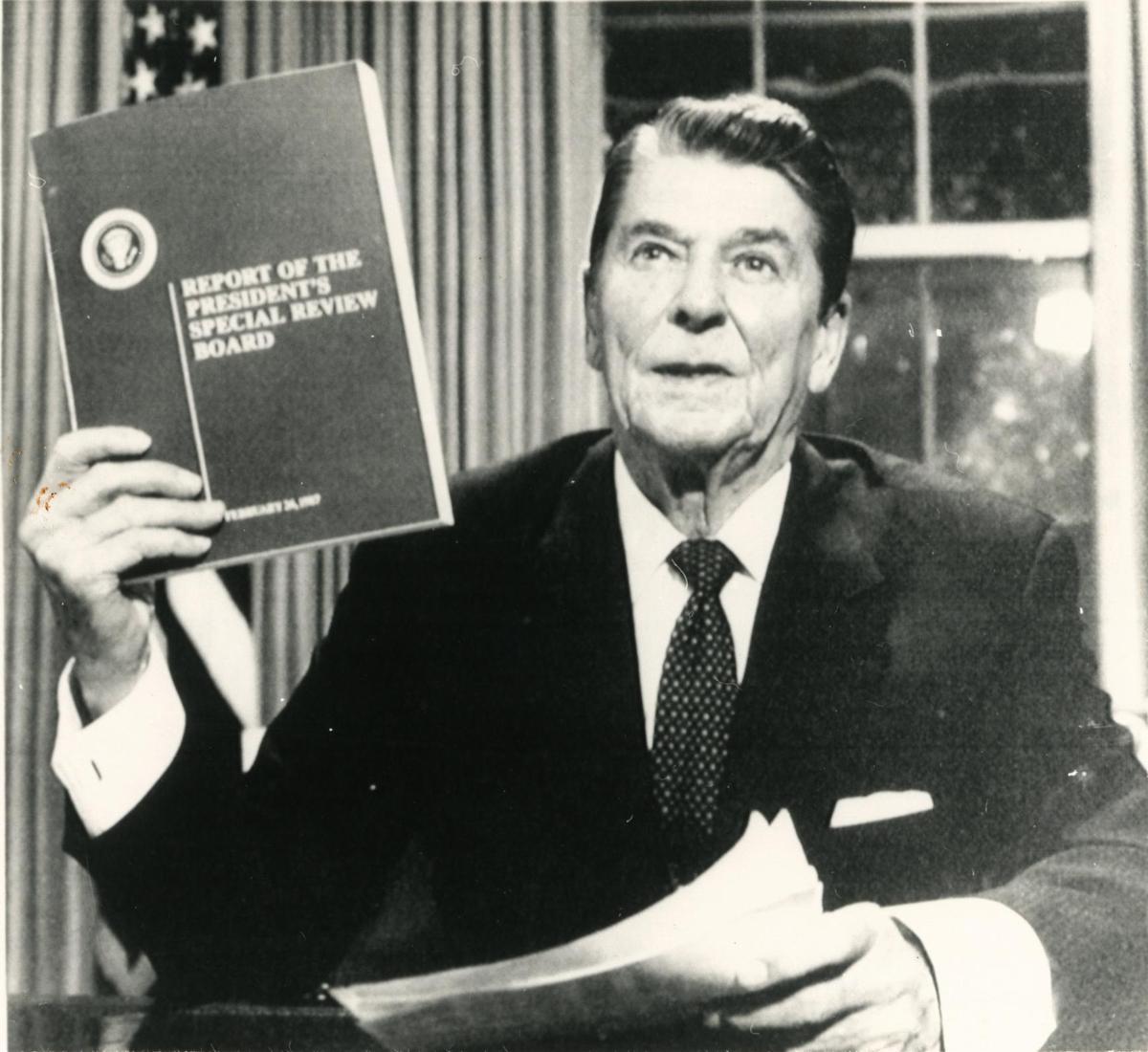
CONTROVERSIAL AFFAIR: U.S. President Ronald Reagan holds a copy of the Tower Commission Report on the Iran- Contra affair while posing for photographers in the Oval Office after he addressed the nation on television in Washington on August 12, 1987. Reagan said he was ‘mad as a hornet’ about damage to his administration from the Iran-Contra affair.
| Photo Credit:
The Hindu Archives
This 10-year-long pro-revolution ‘moment’ was used extensively in the following decade, for the regime to consolidate and expand its new foreign policy. At its heart, the institutions that this war birthed (such as the Quds Force, with Quds meaning Jerusalem) represented a new universalist logic that inherently shunned nationalism and focused on the Islamic Ummah. Few other visual signifiers are evidence of this logic than the IRGC coat of arms, which does not feature a map of Iran but of the globe. In fact, Tehran acted early to plant the seeds of Shia consolidation (ostensibly characterised as liberation/revolutionary movements) in several states, such as through the Supreme Council for Islamic revolution in Iraq (SCIRI, 1982), the Islamic Resistance in Lebanon which later became Hezbollah (1982), the Islamic Unity Party in Afghanistan (1989), and the Ansar Allah in Yemen (or the Houthis, 1992). While Iran helped create some of these groups, it nourished and supported others. This novel manner of regional power projection through proxy was not wholly a threat to the United States. However, the actions of some — such as Imad Mughniyeh of Hezbollah — presented immediate threats to the United States, as was evidenced by Hezbollah’s 1983 Beirut bombings of U.S. military barracks and the 1985 hijacking of TWA Flight 847.
Inherently, and especially due to the anti-Israel elements of such a hub-and-spoke policy, the United States naturally viewed Tehran as an inherently hostile power. Khomeini himself had long called for the expulsion of American troops from the Middle East and acted to that end even years before the 1979 revolution — such as through Mansur’s 1964 assassination after the U.S.-Iran SOFA, which Khomeini had chastised as a capitulation to Washington. Hence, references to U.S. bases in other states in Mr. Khamenei’s November 2025 speech draw from a decades-old position.
However, the actual lived experience of Iranian and American leaders’ engagement with each other would prove to be far more complicated and more reflective of the duality that both states have displayed towards each other — except with the bedrock having changed from cooperation to contestation.
The entrenchment of Iran’s approach to an ‘arrogant’ power
By the turn of the century, regardless of Iran’s active interventions in regional states, Tehran remained focused on immediate threats in the neighbourhood. Under Mohammad Khatami’s reformist Presidency (1997- 2005), this meant that tackling some of these threats required alignment with U.S. efforts, and relegating Tehran’s ideological disposition to the background (even as Tehran’s public rhetoric remained anti-American). In the 21st Century, the duality that both the United States and Iran nourished towards each other matured and reached new heights.
In fact, both as a recognition of its own conventional military limitations as well as to justify periods of cooperation, the Supreme Leader has often reiterated a pre-revolutionary Khomeini-era innovation — ‘strategic patience’. Practically, this has always meant to be a message to the Iranian public that Iran’s ideological resolve against the United States remains firm, but the national interest of the time demands a non-confrontational approach. Often, this innovation has also allowed Tehran to save face and preserve deterrence (its effectiveness is a different issue).
For the Islamic Republic, this chapter of U.S.-Iran ties first manifested in Afghanistan, where the withdrawal of Soviet forces had spawned a civil war by the early 1990s. The group that ultimately emerged victorious and took over effective control of Afghan territory (except the North) represented a virulently sectarian anti-Shia force — the Taliban. Even as Iran’s Afghanistan policy later underwent several pragmatic shifts (especially post-2021), Tehran remained categorically hostile to the Taliban during the Islamic Emirate of the late 1990s and supported the Panjshir Valley-based Northern Alliance led by Ahmad Shah Massoud. For the Clinton Administration, which remained similarly disposed against the Taliban, its actions in Afghanistan required regional support. Such support was readily offered by Iran and sanctioned by Supreme Leader Ali Khamenei himself. Following the 9/11 attacks (for which Iranians poured into the streets in solidarity with American lives lost), the Quds Force — led by Qassem Soleimani — actively cooperated with the U.S. military after Washington declared war on Afghanistan and provided crucial targeting intelligence and operational assistance. The United States reciprocated by helping Iran identify Al Qaeda cells in the country. Even after the Taliban’s removal from Kabul, Iran lent support to the 2001 Bonn Conference, which led to Hamid Karzai’s eventual appointment as Afghanistan’s provisional leader.
However, President George Bush’s infamous inclusion of Iran in his ‘Axis of Evil Speech’ in 2002 (following an Israeli interception of an Iranian vessel allegedly carrying arms for Palestinian groups), decisively breached the brief cooperative alignment that their efforts in Afghanistan had yielded; another display of Washington’s arrogance, from Tehran’s view. At home, this was arguably the first (of several) dents to the Iranian reformists’ credentials to advocate for engagement with the United States, even as Khatami blamed Bush’s characterisation of Iran on the “influence of warmongers” on the President.
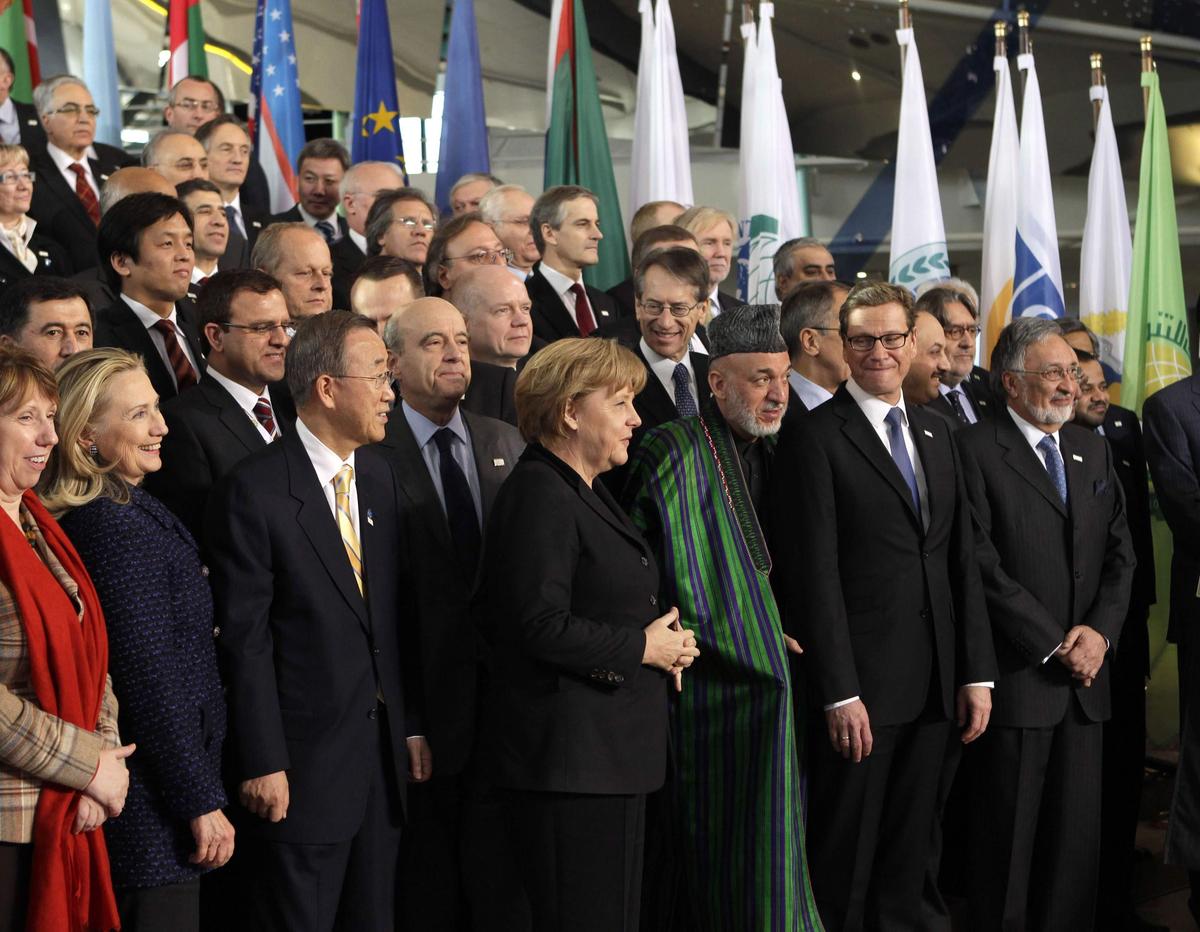
BUILDING ANEW: (Front row L-R) EU foreign policy chief Catherine Ashton, U.S. Secretary of State Hillary Clinton, U.N. Secretary-General Ban Ki-moon, German Chancellor Angela Merkel, Afghan President Hamid Karzai, German Foreign Minister Guido Westerwelle, and Afghan Foreign Minister Zalmay Rassoul join foreign ministers and world leaders for a group photo during an international conference on the future of Afghanistan, in Bonn, December 5, 2011. Iran was among the foreign governments to lend support to the conference.
| Photo Credit:
REUTERS
Under Mahmoud Ahmadinejad, Khatami’s (conservative) successor, the U.S.-Iran relationship arguably saw an entrenchment of Tehran’s dual approach to the United States, in Iraq. On one hand, the 2003 U.S. invasion of Iraq represented a grave threat to Tehran due to its own covert (but modest) nuclear weapons programme active since the late 1990s, even as Saddam’s removal was in line with Tehran’s objectives. It is to ward off this threat that Mr. Khamenei issued his oft-recalled fatwa against nuclear weapons, in 2003, and suspended the programme. However, in the years following the end of the U.S.’s Shock and Awe operations that toppled Saddam, Iran masterfully leveraged the U.S.’s inexperience and unfamiliarity with Iraq’s tribal and deeply sectarian landscape to engineer Iran-friendly Shia political forces in the country.
For instance, while Iran publicly and officially objected to the U.S. appointment of Paul Bremer (a stranger to the Middle East) as the Coalition Provisional Authority’s Administrator in Baghdad, Tehran invested heavily in cultivating its own network of Tehran-leaning actors (such as those in SCIRI) who could pack the new Iraqi institutions that the United States helped put in place. In any case, Mr. Bremer’s decision to dissolve Iraq’s military and intelligence and sacking of all Ba’ath affiliated personnel had alienated the country’s Sunnis and allowed formerly exiled Shia politicians (supported by Iran) to fill government positions. Testimony to Tehran’s successful power play was the resounding victory that pro-Iran parties, including SCIRI, Al-Dawa and the Iraqi National Congress, secured in Iraq’s 2005 elections. Even as Washington remained the predominant power in Iraq, especially due to its strong military presence, Iran ensured sufficient ways to prevent an anti-Shia government from taking power in Baghdad.
Ultimately, however, both the U.S.’s ineffectiveness in assessing Iraq’s sectarian divisions as well as the alienation of Iraqi Sunnis fuelled the rise of jihadist forces such as the Islamic State of Iraq and Syria. Consequently, in the following decade, both Iran and the United States found themselves aligned again, in fighting the Islamic State in Iraq, even as both remained on opposite sides in Syria’s civil war (2011-2024). In the years after ISIS fell in Iraq in 2019, Iran successfully subverted the Popular Mobilization Forces to act as new armed protectors of Iranian influence in Iraq and a threat-in-being against U.S. bases in the country.
In the same decade, Tehran also faced the starkest iteration of Washington’s inconsistency, especially vis-à-vis the efforts to reach a deal to end sanctions on Iran in return for limits to (or the complete elimination of ) Iran’s nuclear programme. This has led to a recurring cycle of engagement with a modicum of good faith, a breakdown in talks, overt hostility and indirect violence, and re-engagement with good faith further reduced. This cycle continues to date, except that each iteration has spawned more violence by the end, culminating in the first-ever direct U.S. military strikes on Iran in June 2025, and Iran’s (again, symbolic) retaliation against the U.S. military’s Al-Udeid airbase in Qatar.
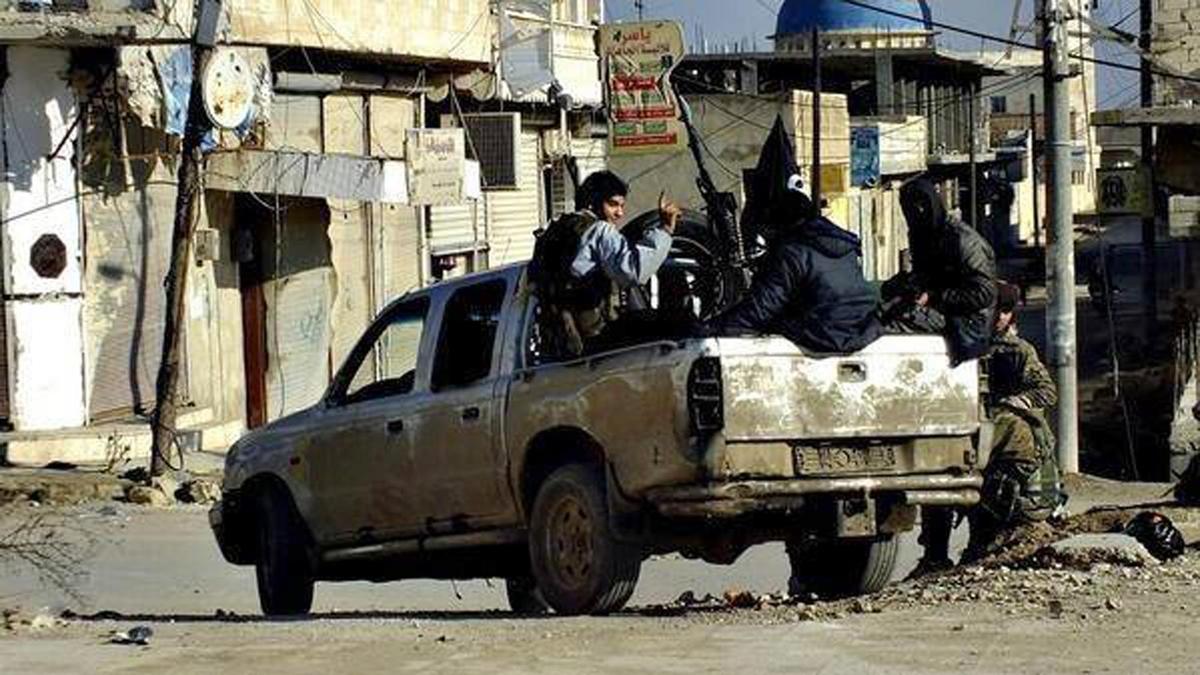
RISING THREAT: This undated image posted on a militant website on January 14, 2014 shows fighters from the al-Qaeda- linked Islamic State of Iraq and Syria (ISIS) marching in Raqqa, Syria.
| Photo Credit:
AP
Tehran succeeded in securing a nuclear deal with the Obama administration in Washington in 2015, reaped immediate and urgently needed economic benefits, and then faced a unilateral withdrawal from that deal by the Trump Administration in 2018; another volte face. This U.S. withdrawal occurred despite both the IAEA and U.S. intelligence assessing that Iran was in compliance with the agreement’s provisions.
Mr. Trump’s subsequent imposition of a ‘Maximum Pressure’ campaign with new sanctions against Iran (and declaring the IRGC as a foreign terrorist organisation) ensured that Iran’s Reformist President Hassan Rouhani (who led efforts towards the nuclear deal) faced a more decisive loss of face than Khatami in 2003. In response, as Washington’s stock fell further in Tehran (more so with the U.S. assassination of Qassem Soleimani
in 2020), Iran further strengthened the sponsorship of its formidable proxies in Lebanon, Yemen, and Iraq. It was the Kataib Hezbollah in Iraq (formerly part of the PMF) that Iran utilised in responding to the U.S. attack on Soleimani, by (symbolically) attacking the U.S.’s Ain al-Asad airbase in Iraq’s Anbar province.
By 2019, Iran had also displayed a marked ability to threaten Saudi and Emirati oil facilities, even as both these Gulf powerhouses were growing increasingly wary of conflict in the Middle East, which boded ill for their ability to draw in greater Western investments to diversify their economies. By 2023, Arab countries were substantially testing rapprochement with Iran and an expansion of ties, even as Tehran and Washington remained bogged down in fresh (but indirect) negotiations for a nuclear deal under the Biden Administration (which never came to fruition).
ESCALATION: U.S. soldiers walk past a site of Iranian bombing at the Ain al-Asad air base, in Anbar, Iraq, on January 13, 2020. The airbase was struck by a barrage of Iranian missiles, in retaliation for a U.S. drone strike that killed Gen. Qassem Soleimani.
| Photo Credit:
AP/PTI
The Trump administration’s antagonistic position against Tehran, both due to Israeli encouragement as well as Mr. Trump’s personal need to diverge from Obama-era policies, had already brought the trust deficit between Tehran and Washington to its deepest point. Within Tehran, however, Iran’s leaders continued to favour the dual approach it traditionally followed and had earlier refrained from substantial responses to Mr. Trump’s actions. It must be noted that while the Reformist or Conservative position of Iran’s elected political leadership is important domestically, the sounding board of the popularity of their foreign policy decisions is not the Iranian electorate. Instead, their successes or failures represent their ability (or lack of it) to convince the Supreme Leader’s office of when to choose engagement (or to shun it). Ultimately, all strategic decisions are legitimised by the Supreme Leader’s office and the Leader’s coterie of senior advisers, some of whom are also associated with the Guards. It is this setup that allows a sense of continuity in Iran’s approach to Washington — with the need to manage the ‘arrogant’ superpower being an abiding objective.
Iran’s present approach to Washington: Continuity amidst disruption
Between 2023 and 2025, as Israel unleashed an unprecedented wave of violence across the Middle East in response to Hamas’s October 2023 terror attacks, Iran suffered a decimation of its architecture of regional influence. This included the almost overnight decapitation of Hezbollah’s leadership, the fall of the Assad regime in Damascus, and a recalcitrant Baghdad that was successful in preventing Iraq’s Shia militias from significantly intervening in Syria and keeping Iraq away from the fighting that had also brought Iran and Israel on the path of direct hostilities (another first). In any case, the Iraqi population (including its Shia constituents) has been increasingly asserting its own identity, with the elections of both 2021 and 2025 showing reduced Iranian influence. This has forced Iran to acquiesce to a new reality, where the main pillars of its axis of resistance now focus on self-preservation, to live to fight another day.
Most importantly, however, Iran’s domestic conditions have grown abjectly worse, with Tehran facing its longest period of economic crises in modern history due to international sanctions, compounded by water scarcity and falling living conditions. Tehran’s leadership is cognisant of the restive nature of its population, which has already manifested in multiple rounds of protests against state repression, economic mismanagement, and corruption. By March 2024, Mr. Khamenei himself was publicly (but implicitly) chastising the then Prime Minister and his potential successor as Leader, Ebrahim Raisi, of categorical economic failures.
Mr. Khamenei has also publicly recognised that the solution to Iran’s economic crises is “external”, meaning sanctions relief, and in turn, meaning diplomatic engagement. While the Islamic Republic has almost always been a sanctioned economy, its current conditions are arguably unprecedented, and economic need has emerged as a strong catalyst for Iranian engagement with the United States. In any case, following the 2015 nuclear deal, Iran was quick to secure several major commercial deals with Western companies, including a large order from France’s Airbus for 118 aircraft.
Few other developments reflected Tehran’s compulsions as much as the developments of 2025. The first indication of Iran’s fresh need for engagement was Iran’s strong openness to dialogue (expressed both by elected leaders such as President Masoud Pezeshkian and hardliner advisers to the Leader such as Ali Shamkhani) with the second Trump administration as it took office in January. This is especially as the Trump administration had arguably heaped more insult and injury onto Iran’s political and military leadership than past U.S. Presidents, in his first term.
Second, as Washington and Tehran began indirect talks in April with negotiations progressing to a fifth round by May, Iranian leaders were authoring op-eds in both U.S. and Europe-based foreign policy media, praising Mr. Trump as a pro-peace President, pandering to his need to criticise the older Biden administration as ineffective, and actively inviting American businesses to invest in Iran.
Third, and most prominently, despite the joint U.S.-Israeli bombardment of Iran in June representing that pre-eminent arrogant threat that the Islamic Republic has always warned its people about (and which killed senior members of Iran’s military leadership, including IRGC Chief Hossein Salami), Iran still kept the road to engagement open.
The Israeli attack on Iran did not occur in the absence of Iran-U.S. diplomatic engagement, but rather at its height, which would have theoretically implied a complete abandonment of Iranian contact with the United States due to the regime’s ideological imperatives. However, the Iranian President was asserting — even as Israel’s bombing campaign was underway — that Iran was open to continuing negotiations if Washington pressed Israel to stop. Needless to say, such assertions cannot be made without the Leader’s blessing/encouragement. In fact, even as the Trump administration’s priorities have wavered amidst a mercurial presidency, Tehran’s leaders have rarely ruled out talks indefinitely and have instead stressed on the need for good faith as a premise.
As recently as November 2025, Iran’s Supreme National Security Council Secretary, Ali Larijiani, stated that Iran is open to “real negotiations” with the United States but not “fake talks” with “pre-determined outcomes”. This characterisation reflects Iran’s impelling need for sanctions relief but also encapsulates the fact that even as Tehran continues to view Washington as arrogant, it needs to ensure that this istekbar does not create fresh threats to the regime at a sensitive time in its history, through continued openness to engagement.
Bashir Ali Abbas is a Senior Research Associate at the Council for Strategic and Defense Research, New Delhi, and a former South Asia Visiting Fellow at the Stimson Center, Washington DC. Views expressed are his own.
[ad_2]
Iran’s relationship with the United States: An estranged friend to an ‘arrogant’ power


