


“With its nominal GDP crossing $4.19 trillion, India has become the world’s fourth-largest economy. Yet, its GDP per capita tells a contrasting story, highlighting the gap between overall growth and average economic output per person”
Addressing the India-Japan Economic Forum in Tokyo on August 29, 2025, Prime Minister Narendra Modi said, Indian economy will “very soon” be the third largest economy in the world. Earlier, in May 2025, NITI Aayog CEO B.V.R. Subrahmanyam noted that India had already become the world’s fourth largest economy, behind only the United States, China and Germany. Further, he said India could move up to the third position within two to three years.
As per the International Monetary Fund (IMF) World Economic Outlook data, as of April 2025, India is ranked as the fourth largest economy of the world, with an estimated nominal GDP of approximately $4.19 trillion. Comparatively, the first three economies are estimated at: the United States $30.51 trillion; China $19.23 trillion and Germany $4.74 trillion.
Top 5 economies by nominal GDP.
| Photo Credit:
Special Arrangement
India lags on per capita GDP
While India’s nominal GDP places it among the world’s top economies, its GDP per capita paints a contrasting picture. A standard proxy for individual economic well-being, GDP per capita shows that India lags far behind these three economies.
The same IMF report shows India’s GDP per capita at approximately $2,878. In comparison, the United States stands at $89,105; China at $13,687; Germany at $55,911 and Japan at $33,956. India’s global rank on this measure falls anywhere roughly between 135 and 142. Remarkably, even war-torn countries or those facing political instability such as Iran, Iraq, Russia, Ukraine and Turkey report GDP per capita levels higher than India. This underscores the wide gap in individual average economic output despite the country’s aggregate economic growth.
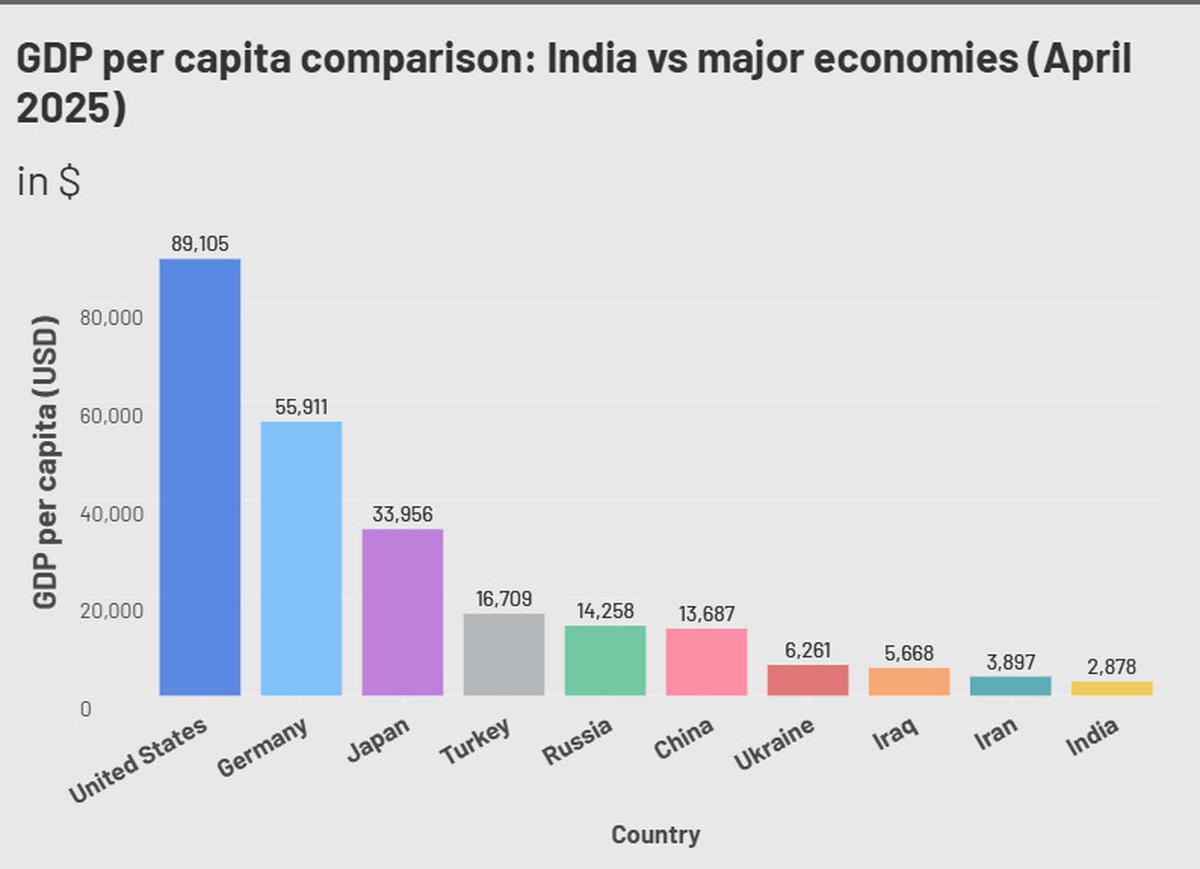
GDP per capita comparison.
| Photo Credit:
Special Arrangement
Why the difference?
The stark contrast between India’s overall GDP rank and its GDP per capita rank is largely explained by its population size. According to the United Nations’ demographic report, India’s population reached 146.39 crore by April 2025. While GDP measures the total value of goods and services produced, GDP per capita divides this output by the number of people. With such a large denominator, India’s per-person average would naturally tend to be much smaller. In contrast, advanced economies with smaller populations, such as Germany or Japan, record higher per capita incomes despite having smaller total GDP. In fact, even China, the world’s second-largest economy by nominal GDP, has slipped to sixth place in per capita GDP, with countries such as Turkey and Russia surpassing it. This highlights how population size plays a major role in determining per-person economic output.
Purchasing Power Parity
The distinction, between nominal- and per capita GDP, is further illustrated through another lens of comparison: Purchasing Power Parity (PPP). That is, nominal GDP per capita measures income in U.S. dollars, but it doesn’t reflect the cost of living within the country. According to the IMF, India’s PPP-adjusted GDP per capita is approximately $12,130 in April 2025. In India, the PPP-adjusted GDP per capita is higher than the nominal figure because everyday expenses are relatively lower in India than in advanced economies. In spite of PPP-adjustment, India’s level remains far below that of the United States, Germany, China or Japan.
Limitations of GDP and per capita measures
The GDP reflects the overall size of a country’s economy but doesn’t reveal how wealth is distributed across its population. While GDP per capita provides a rough sense of the scale of resources available per person, it does not capture variations in actual income or living standards.
What do economists say?
Economists observe that the gap between the two is not just a statistical quirk but reflects how growth is distributed across its population. A rising GDP could boost global influence, fiscal capacity, attract investors, or fund infrastructure. However, the living standards of ordinary people might remain constrained if productivity, wages, and employment opportunities do not improve.
Experts argue that India’s strategy lies in harnessing its young workforce.
| Photo Credit:
Unsplash Images
Leveraging the demographic advantage
Experts argue that India’s strategy lies in harnessing its young workforce. If more Indians shift from low-productivity work into higher-paid, skilled jobs, then the nominal headline GDP growth can translate into a tangible household growth. Institutions such as the IMF and World Bank highlight that bridging this gap requires raising productivity across sectors, investing in human capital through education and health, and creating more inclusive opportunities through better wages and employment.
In short, India’s growth story will feel complete only when the nominal GDP charts and its people rise together.
(The writer is an NISM & CRISIL-certified Wealth Manager and certified in NISM’s Research Analyst module)
Published – February 03, 2026 03:08 pm IST
Source: https://www.thehindu.com/children/national-gdp-vs-per-capita-gdp/article70524607.ece


