


[ad_1]
Nishant Agarwal picks me up from my hotel in San Jose on a crisp Tuesday morning. He wants to take me to a new South Indian restaurant called Mylapore that has become the talk of the town. I ask him what makes it so popular, given the number of Indian restaurants already dotting the Valley. Agarwal, a 40-something acquaintance who I’d met through overlapping circles in Silicon Valley, thinks for a moment before answering: “The food is really authentic, so much so that on weekends, there’s a queue outside.”
As we drive to Pleasanton where the restaurant is located, Agarwal mentions, almost in passing, that he works at ByteDance, the Chinese company that owns TikTok.
“Even in these times,” I exclaim, becoming self-conscious almost instantly. Tariffs, layoffs, politics, trade barriers, bans, EVs — there are heaps of touchy topics in the U.S. these days, and I keep reminding myself to pause, to self-censor, to choose my curiosity carefully.
Agarwal senses my discomfort. “At this time, it’s okay,” he says. “Let’s see how it goes with ‘the Trump’.”
It has been almost a year since Donald Trump’s return to power as President of the United States, and the aftershocks are no longer abstract. Visa rules are tightening again, H-1B fees have crept up, and renewals are taking longer. Even seasoned engineers speak in lowered voices about travel, paperwork, and whether a job change is worth the risk.
I have come to Silicon Valley to unfurl, for myself, the chaos born of a cocktail of divisive politics and the unconstrained AI revolution. I have only recently moved to the U.S., crossing not just geographies but professional worlds, leaving behind the predictability of Europe for a country in mid-argument with itself. On one side are tightening borders, and polarising factions; on the other, an AI boom so unconstrained that it seems to race ahead of regulation. I want to see how these forces co-exist in the place where they collide most visibly. That question has brought me to the Valley.
Losing entry level jobs to AI
I had landed in San Francisco earlier that day and taken the Caltrain down to San Jose to meet Agarwal. The line will eventually be electrified, even reimagined for high-speed travel. For now, it chugs gently, making its way through Palo Alto, Mountain View, and Cupertino — names synonymous with Apple, AMD, Adobe, Intel, Meta, and Stanford University.
From the upper deck, I look around. The carriage is filled with people bent over MacBooks. Some are young, campus-bound perhaps. Others have greying hair. What unifies them is a quiet uniform: jeans, sneakers, hoodies, AirPods in, iced lattes within reach.
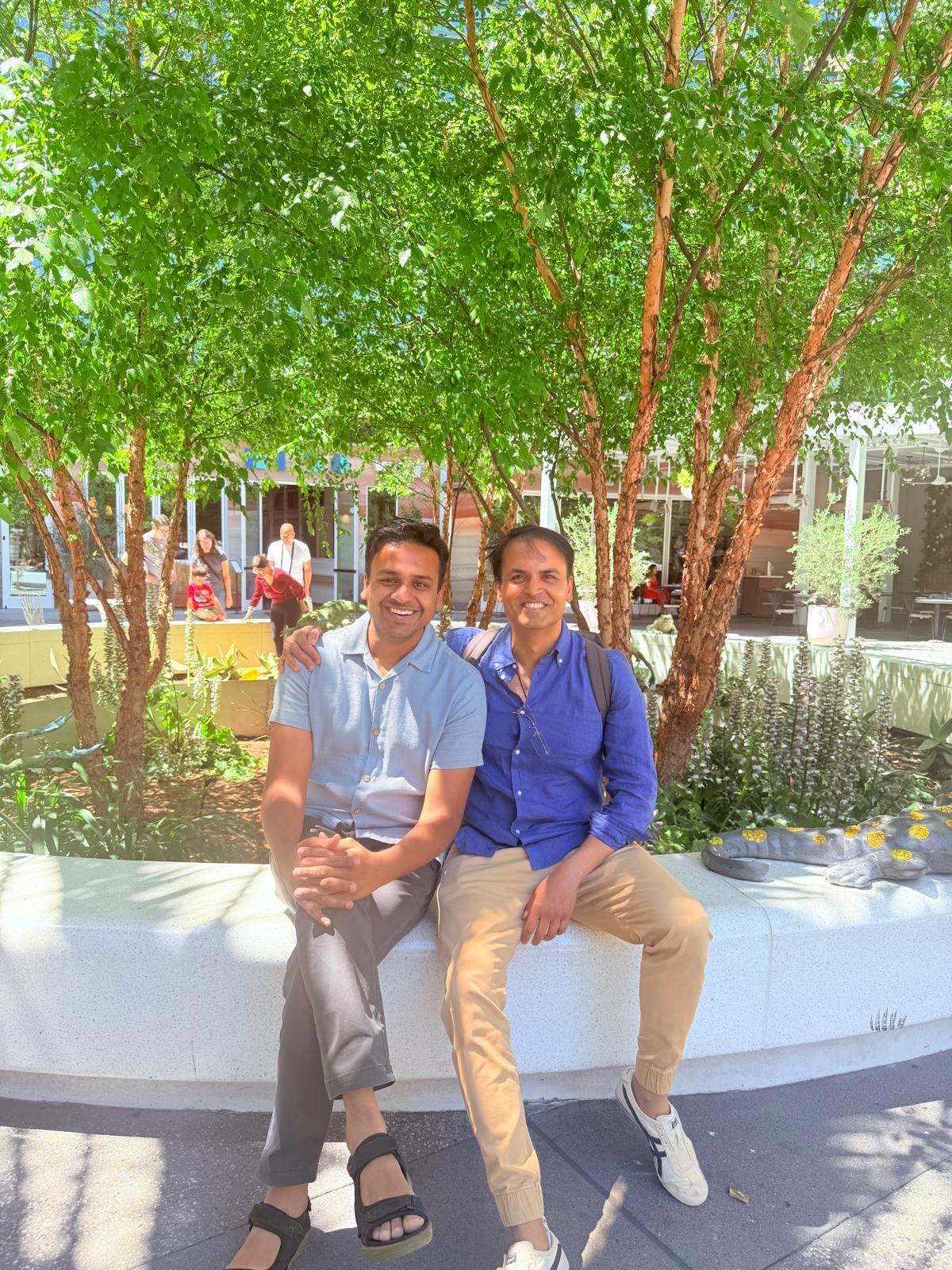
Nishant Agarwal (left) with the writer, Nitin Chaudhary
Outside, it is warm and sunny. Not far away, rocky hills seize the horizon, their steely greys contrasting with the light, shiny blue of the Californian sky. It looks idyllic, a place to walk, to think, to wonder, to create. Later, as Agarwal drives me through this landscape, I ask him how serious the tech layoffs are, the ones everyone seems to be worried about. “They’re real,” he tells me. “Every day, hundreds are losing their jobs. Entry-level jobs have completely disappeared. It’s not a good time to come study in the U.S.”
“Why so?” I wonder aloud, as we sit at Mylapore, eating ghee podi idlis dipped in spicy sambar. It is too heavy a meal for a light morning, but I am hungry, and the food reminds me of days back in India. So, I keep eating. “Well, that’s not because the companies are suffering,” Agarwal explains patiently, “but because they’re pivoting — for and because of AI. Some companies like Apple have hired AI agents as interns to test the waters. Everyone’s trying to optimise, and at the same time, hoping to land on a business model that pays. Until then, the churn will continue.”
What share of jobs where Indians are employed in Silicon Valley will be impacted, I wonder. Done with food, Agarwal brings a paper napkin and takes out a pen. “Roughly 20%-25% of tech workers in Silicon Valley are originally from India,” he starts jotting on the back of the napkin. “Given that Silicon Valley employs roughly 250,000 high-tech workers, we are talking about 50,000 Indians working here. Since we are talking about entry-level jobs getting impacted first, that would be around 30% of the lot. So, all in all, roughly 15,000 Indians in the Valley could be in roles where AI plays a substantial part of their tasks.”
Fewer students from India
Later that afternoon, Agarwal drops me at the town centre, in Santana Row. Designer stores and expensive restaurants line the street, its central walkway shaded by tall trees offering a brief relief from the blazing sun. I sit beneath one, watching families, couples, and lone wanderers pass by, struck by the number of Chinese faces, something I haven’t noticed back in Texas, where I live now.
“It’s the first time in years that more Chinese students than Indians have come to this country,” Phiroze Nagarvala tells me the next day. “Not a good omen for India.” We are sitting in a modern Mediterranean-style cafe in Berkeley, overlooking the Pacific Ocean, eating falafel bowls for lunch. I am in Berkeley, an hour’s drive from San Jose, to meet Nagarvala, a Parsi who came here as a student from Bombay in 1961 (“when it was still Bombay,” he reminds me). He has taught mechanical engineering at UC Berkeley and worked at Berkeley National Labs in the hills overlooking the campus. He has a good pulse on the student cosmos.
Dream unravels
In 2025, there were 5.7% fewer Indian students abroad (1.2 million) compared to 2024 (1.33 million) [according to the Ministry of External Affairs].
In the first half of 2025, F-1 visas to Indian students dropped by 44%. Chinese visa issuances fell by 24%. In contrast, the number of Vietnamese students receiving F-1 visas jumped by 20%.
Source: ICEF Monitor
Universities in the U.S. are like periscopes — what happens there remains hidden from usual sight but often marks future shifts. Has Trump’s return changed how universities accept foreign students, I ask. “Possibly. But if they don’t accept students from India or China, who else will study the sciences?” he replies with a grin. “The difference,” Nagarvala continues, “is that Indians come to stay, while the Chinese tend to go back. They have to care for their parents, and being single children, they bear that responsibility more than us Indians. Any policy Trump dreams up should factor that in.”

Some of the effects of recent policy changes are already visible. As of November 2025, the number of newly enrolled international students at U.S. universities has dropped by 17% following new restrictions on student visas. Among the universities already seeing fewer international students, the reasons are no longer mysterious. Nearly all (96%) point to visa application anxieties, while more than two-thirds cite travel restrictions. The figures come from the Institute of International Education, which has surveyed 825 U.S. colleges and universities. Most institutions report that the drop is sharpest among Indian students, enough to drag down the national numbers on its own.
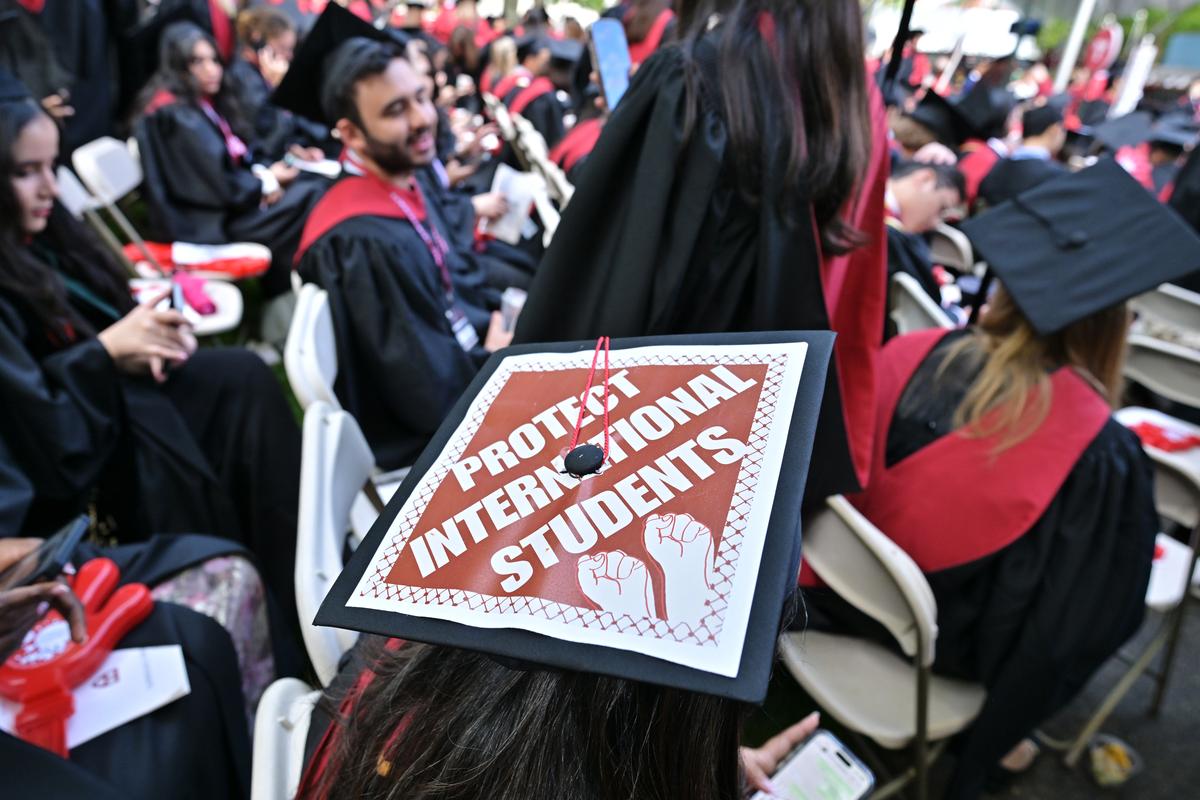
CAMBRIDGE, MA – MAY 29: A Harvard University graduate with a message in support of international students on her mortarboard sits with fellow students at the start of commencement exercises at Harvard University in Harvard Yard May 29, 2025, in Cambridge, MA. (Photo by Josh Reynolds/For The Washington Post via
| Photo Credit:
Getty Images
Nagarvala and I finish our bowls and step into a European-style neighbourhood of pastel buildings, curated boutiques, and artisanal calm. Between the streets, the sea peaks through. Surfers in dark wetsuits bob on their boards, and far across the bay, San Francisco’s skyline shimmers in the heat haze. We wander over to a Tesla store, outside which a small crowd has gathered in protest.
‘Musk Is Murdering Our Democracy,’ one placard reads. ‘Don’t Buy CyberTrucks! It Killed Three Children,’ says another.
The protesters are all white. I don’t see a single Indian or Chinese face among them.
Occasionally, they shout “Down with Musk”, raising their banners and placards. But the crowd remains gentle. Behind them, outside a cafe, a small band punctuates the slogans with strums of guitars and beats of drums, singing folk songs. Cars passing by honk in solidarity, each honk met with cheers. There is a lightness in the air. The protest feels, strangely, festive.
“Which car do you drive?” I ask Nagarvala as we stand watching. “I’m not answering that,” he says with a smile, and looks away.
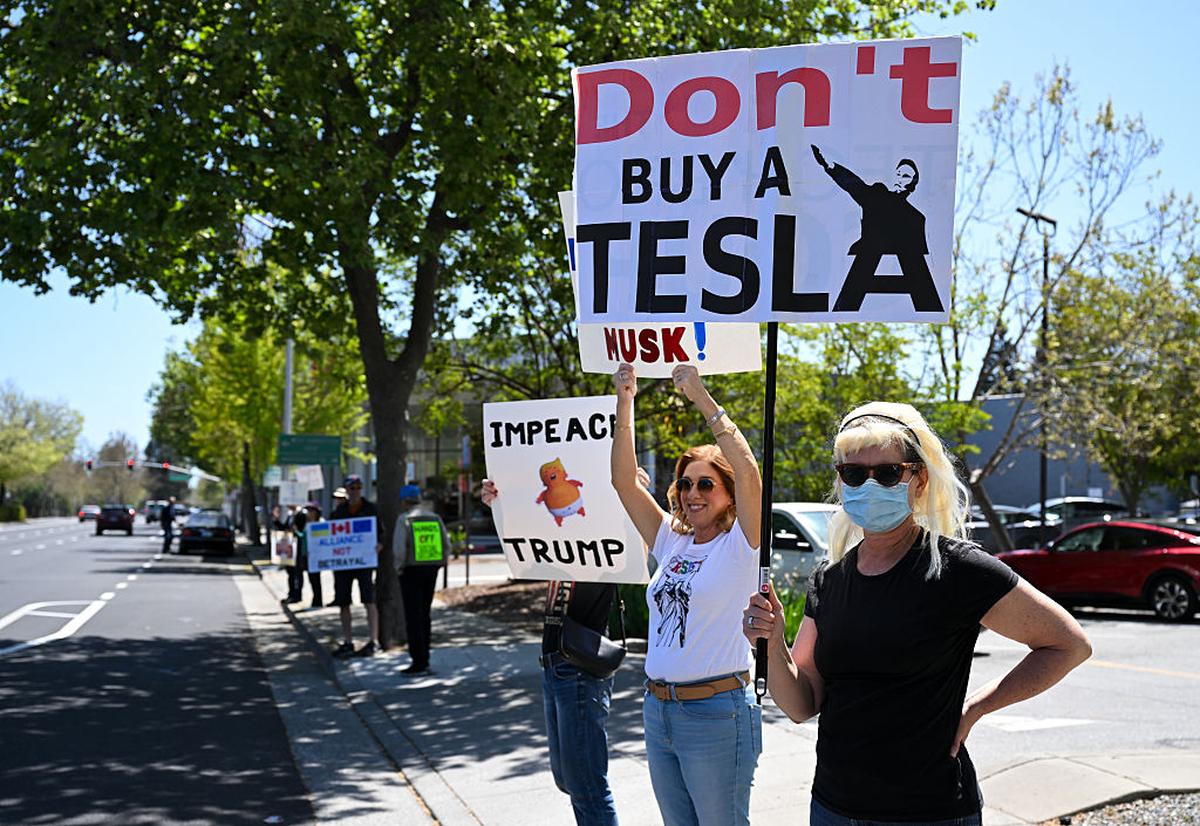
Protesters outside a Tesla dealership in Palo Alto, California, April 12, 2025.
| Photo Credit:
Getty Images
A silver lining
The next morning in San Jose, I walk down East Campbell Avenue, bright and crisp like the days before. On Sundays, it becomes an open-air market. No cars, just foot traffic. Steak sizzles at one stall; at another, homemade kombucha is poured by the jug. There is vegan ice cream, crystal keychains, and families drifting between them all, tasting and lingering with Sunday ease.
I walk to the far end to meet Rahul (name changed to protect identity), once a senior of mine in college and now working in the tech industry in AI. We settle for tea at a shop that sells all things tea — loose leaves, cups, and strainers. ‘Thank you for supporting small businesses,’ reads a sign out front. An elderly woman, possibly the owner, recommends a tea made from berries. She brews it for us on the spot. It tastes tart and refreshing.
Rahul tells me he has finally received his Green Card after 16 years in the country. In between, he’s been laid off twice from big tech firms. He is now preparing to join a start-up. “From Big Tech to a start-up. Quite a change,” I wonder aloud. “Yes,” he replies. “But a Series C or D start-up is worth it. The funding’s in place. Less risk. And you get equity, too.”
I ask him about the ongoing and impending layoffs as we watch the crowd drift past. “Yes, it’s true that AI is cannibalising the entry-level jobs,” Rahul says. “Those roles can be automated first. But the other reason is cost. These companies want to free up capital to invest in energy-intensive data centres. Those will be their temples.”
I ask Rahul the same question I had asked Agarwal — what about the Indians in the Valley?
“The most impacted would be the consulting firms, the likes of Infosys and TCS. That’s because their engineers carry out routine maintenance tasks. Since budgets have shrunk, these tasks can be automated first,” he says. “Outside, Dubai or Abu Dhabi are going all out to attract AI investments. China has had a national AI programme running for almost a decade now, and the speed at which they operate is outshining even Silicon Valley. So, other countries are making substantial investments. However, Silicon Valley is still the beating heart. Many start-ups, even though birthing someplace else, eventually look towards the Valley to set up shop and scale up.”
So, all is not lost, I suppose. “Not at all,” he says. “Us Indians, especially, are very entrepreneurial. I see many actively re-educating to move into AI. In fact, I get calls from lots of Indian managers here asking for advice on how to upskill to be prepared to meet this new reality.”
Rahul is one of the few who sees a sliver of light in the confusion. Instead of resisting change, he has re-invented himself by teaching himself AI, reskilling deliberately, and preparing for a future that is already arriving. He speaks about this new reality with an optimism that doesn’t deny the risks, but refuses to be paralysed by them. And he isn’t alone.
That sentiment surfaces again in a later conversation with another contact, a program manager at Microsoft, who asks to remain anonymous. Yes, she acknowledges, Microsoft has cut roughly 4% of its global workforce in 2025. But the mandate inside the company is unambiguous: do targeted hiring to build AI capabilities, and set a clear expectation that every employee must begin using AI agents in their daily work.
“My job now is to write a one-pager describing user needs and technical requirements and hand it to a coder,” she tells me. “Earlier, that coder would have been human. Now, the first version is always built by an AI agent.” Entry-level roles, she admits, will inevitably thin out. But for people like her, Indians skilled in technology, it also opens a window: not just to adapt, but to lead. There are no formal playbooks yet. The only way forward is self-education till university curriculum catches up. And that, she says, is exactly what most of them are doing.
The Valley after hours
The streets of San Jose are quiet when I return after meeting Rahul. I have no destination, no one to meet. In the dying light, I study the tall buildings surrounding me that are home to SAP, Zoom, Adobe, and other tech giants. The towers stand still, hollow like the ribcages of a dying beast. It is Sunday, yes, but I wonder if this emptiness is permanent, slowly being filled by the silent hum of algorithms running not just around us, but us.
On a paper napkin at Mylapore, Agarwal had sketched the math: tens of thousands of Indians at risk of losing jobs in Silicon Valley in roles already exposed to AI. Rahul had put it more bluntly: survival means re-education. Nagarvala, from another generation, reminded me that Indians have always come here to stay, to find permanence in a place built on flux. I think of them all. For Indians in the Valley, the future lies in reinvention, there seems no other way.
From a distance, I hear music. I follow it to an open-air club. Loud music blares, and lights flicker across the crowd. Inside, people dance, moving like they are in a trance — unsure, perhaps even fearful, of what the future holds. I grab a barstool and reflect on my future. Having moved from Europe to the U.S., I have to confront this new reality and what it means to me.
In Europe, AI had so far lived in conversation, bound by guardrails on ethics and regulation, enclosed in long debates about what should or shouldn’t be built. In the U.S., AI lives in its use, driven by speed, scale, and deployment. A quiet assumption lies underneath — that if something works, it will find its place.
I realise that having moved borders, I need to bridge these two realities. In a perfect world, we need both — some of us looking at AI as a philosophical problem to solve and some of us experimenting with AI to make it a tool that produces economic benefits. Sitting between these two worlds, I find myself valuing both: the European instinct to pause, and the American urge to move, while learning that the real work lies in translating between them.
The writer is a U.S.-based professional with an interest in travel and culture reporting.
[ad_2]
Indians in Silicon Valley: caught between Donald Trump and AI


